This article has been reviewed according to Science X's editorial process and policies. Editors have highlighted the following attributes while ensuring the content's credibility:
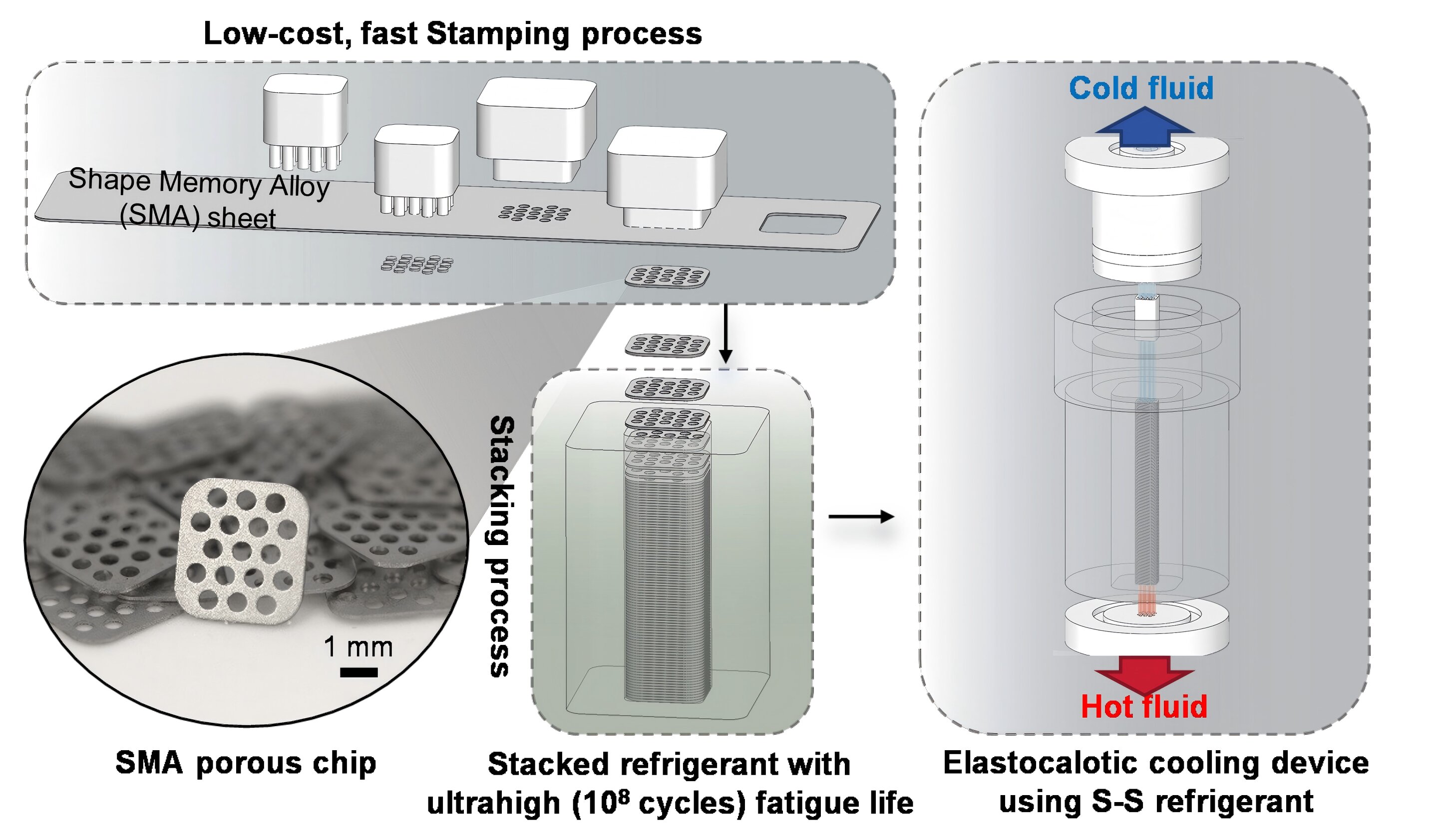
As global demand for cooling continues to grow, the urgent need for sustainable refrigeration technologies is becoming increasingly evident. Conventional vapor-compression systems remain energy-intensive, while the refrigerants can contribute to the greenhouse effect. The Hong Kong University of Science and Technology (HKUST) research team has manufactured a low-cost, ultradurable elastocaloric refrigerant structure, inspired by the stacked porous architecture of honeycombs, that operated for more than 100 million cooling cycles with an estimated service life of more than 10 years.
This manufacturing approach substantially increases production efficiency and reduces costs, paving the way for the practical deployment of elastocaloric cooling. The findings have recently been published in the journal Science under the title "Stacked porous NiTi structure with low cost and ultrahigh fatigue life for elastocaloric cooling."
Elastocaloric cooling absorbs and releases heat through the reversible phase transformation of shape memory alloys (SMAs), offering a highly promising solid-state alternative to conventional refrigeration. However, achieving the combination of rapid heat transfer, high mechanical reliability and low manufacturing cost in SMA refrigerant structures remains a major challenge for practical applications.
Most existing structural forms rely on commercial tubes, plates and wires, or thin-walled structures produced by wire-cut electrical discharge machining. These approaches are often associated with high production costs, slow fabrication and susceptibility to fatigue failure and buckling under repeated loading. Such limitations have hindered large-scale deployment of elastocaloric cooling technology.
Source link