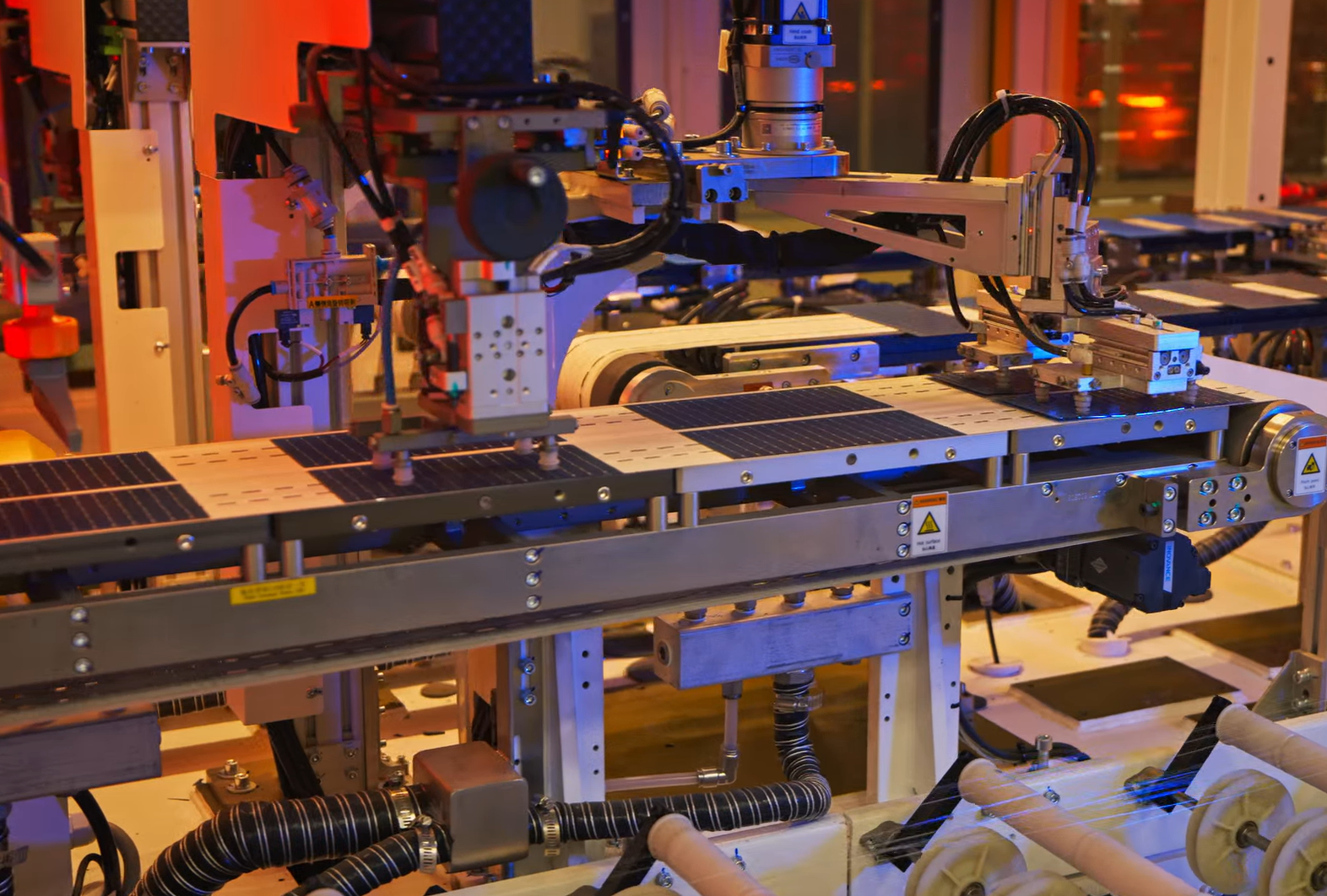
India’s solar manufacturing industry could become a fully integrated global powerhouse by 2047, creating 3.23 million direct and indirect jobs, attracting $89 billion in manufacturing investment, and eliminating the country’s solar import bill, according to a report by the Indian Solar Manufacturers Association (ISMA).
The report outlines a roadmap for India to move beyond module assembly and develop domestic manufacturing capabilities across the solar value chain, from polysilicon and ingots to wafers, cells, and modules. The transition could enable India to capture a significantly larger share of the value generated by domestically manufactured solar panels while strengthening its position in global markets.
Under a current-policy scenario, ISMA projects India’s installed solar capacity to reach approximately 278 GW by 2030, approaching the 292 GW target, before rising to around 1,370 GW by 2047. The latter figure is slightly below NITI Aayog’s current-policy projection of 1,430 GW to 1,650 GW by 2050.
The Vision 2047 scenario accounts for additional electricity demand from emerging industries and infrastructure. Assuming full implementation of planned programs, ISMA estimates that India’s installed solar capacity could reach 313 GW by 2030 and approximately 2,275 GW by 2047, enough to meet nearly half of the country’s electricity demand.
To support this expansion, India’s solar PV manufacturing industry would need to achieve cumulative production capacities of approximately 3,484 GW for modules, 3,128 GW for cells, 2,630 GW for ingots and wafers, and 2,200 GW-equivalent for polysilicon by 2047.
Manufacturing capacity across the solar value chain is expected to expand rapidly, supported by government-backed projects that mandate the procurement of domestically manufactured solar products.
Source link