

An earlier version of this article appeared in The Driven on 15 October 2026. This version has been revised and updated with the most recent registration data.
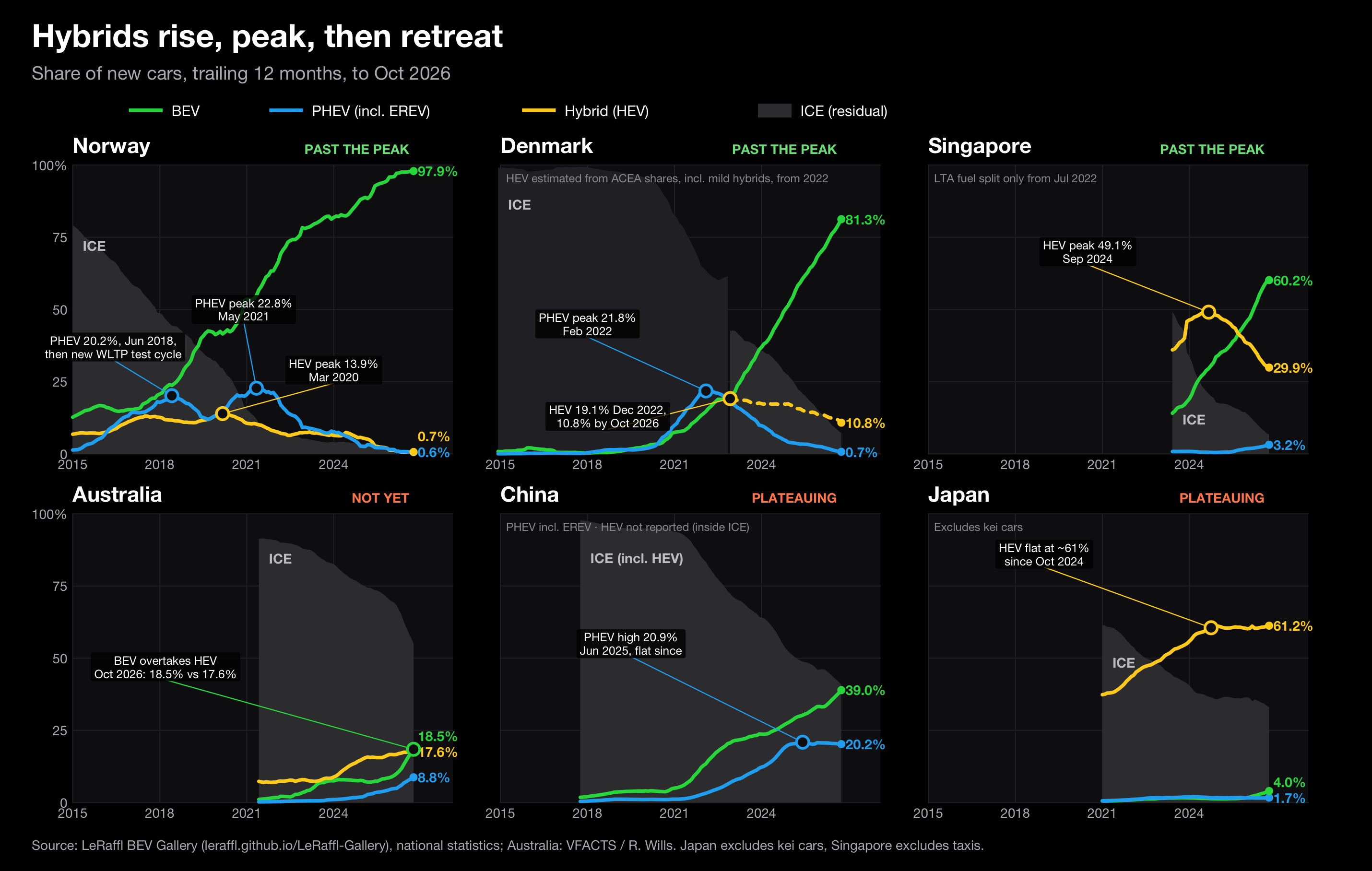
In January 2024, Toyota chairman Akio Toyoda said battery EVs would reach at most 30% market share, with the remainder going to hybrids, hydrogen, and combustion vehicles. Norway’s BEV share was already at about 89% that year. Norway alone cannot settle a prediction about the global market, but it shows that 30% is no inherent ceiling on BEV adoption.
PHEVs are conditional transition vehicles. They earn their environmental case through verified electric kilometres, not through the presence of a charging port.
Mature markets tell the more revealing story. Once battery-electric vehicles offer sufficient choice, charging confidence, and competitive economics, hybrids do not settle into a permanent share of the market. Hybrids may lead early, peak, and then retreat.
Norway. The year is 2015. Hybrid vehicles had gained material market share and plug-in hybrids were beginning to arrive in volume. In 2017, PHEVs accounted for about 18% of new registrations. BEV growth temporarily paused, while hybrids benefited from familiar factories, familiar supply chains, and familiar consumer expectation.
After another PHEV surge in 2020 and 2021, the direction changed. 8% of Norway’s new passenger-car registrations. 3%. Across the first ten months of the year, BEVs held 98% of the market. Hybrids had not become a permanent destination: they had become marginal in new-car sales.
Source link





