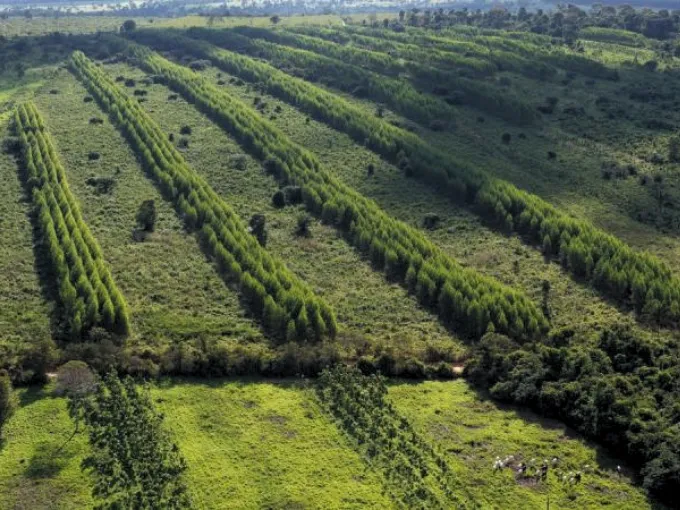
Symbiosis Coalition members Google and McKinsey have signed carbon removal agreements with Working Trees, a company using silvopasture to convert primarily degraded cattle pastures in Brazil into mixed-species systems.
These agreements mark the first-ever silvopasture investment made by Symbiosis as part of its mission to back next-generation nature-based carbon dioxide removal (CDR) by 2030.
With the signed agreements, Google and McKinsey have collectively contracted 320,000 tonnes of CO2 removal from Working Trees to be delivered over a period of 10 years.
On its end, Working Trees will apply the secured funding towards the restoration of 8,700 hectares of degraded and semi-degraded pasture as part of a 50,000 hectare project spanning across the southeastern Amazon and central Cerrado in Brazil.
“Our mission at Working Trees is to mobilize the next generation of cattle ranching – where producers and nature thrive together – by partnering with ranchers to deploy silvopasture at the million-hectare scale,” said the company’s CEO, Leif Gonzales-Kramer.
On a global level, cattle grazing is recognized as the leading cause of deforestation and forest fragmentation, resulting in meaningful soil degradation in different regions around the world.
Silvopasture is a type of agroforestry system that can help address the impact of cattle grazing, helping reduce the pressure of deforestation while enabling the sequestration of significant amounts of carbon dioxide.
This agroforestry approach entails purposefully integrating trees into degraded cattle pastures, where they help restore the connectivity of the landscape while also improving soil health and supporting better cattle outcomes on fewer hectares of land.
Source link