
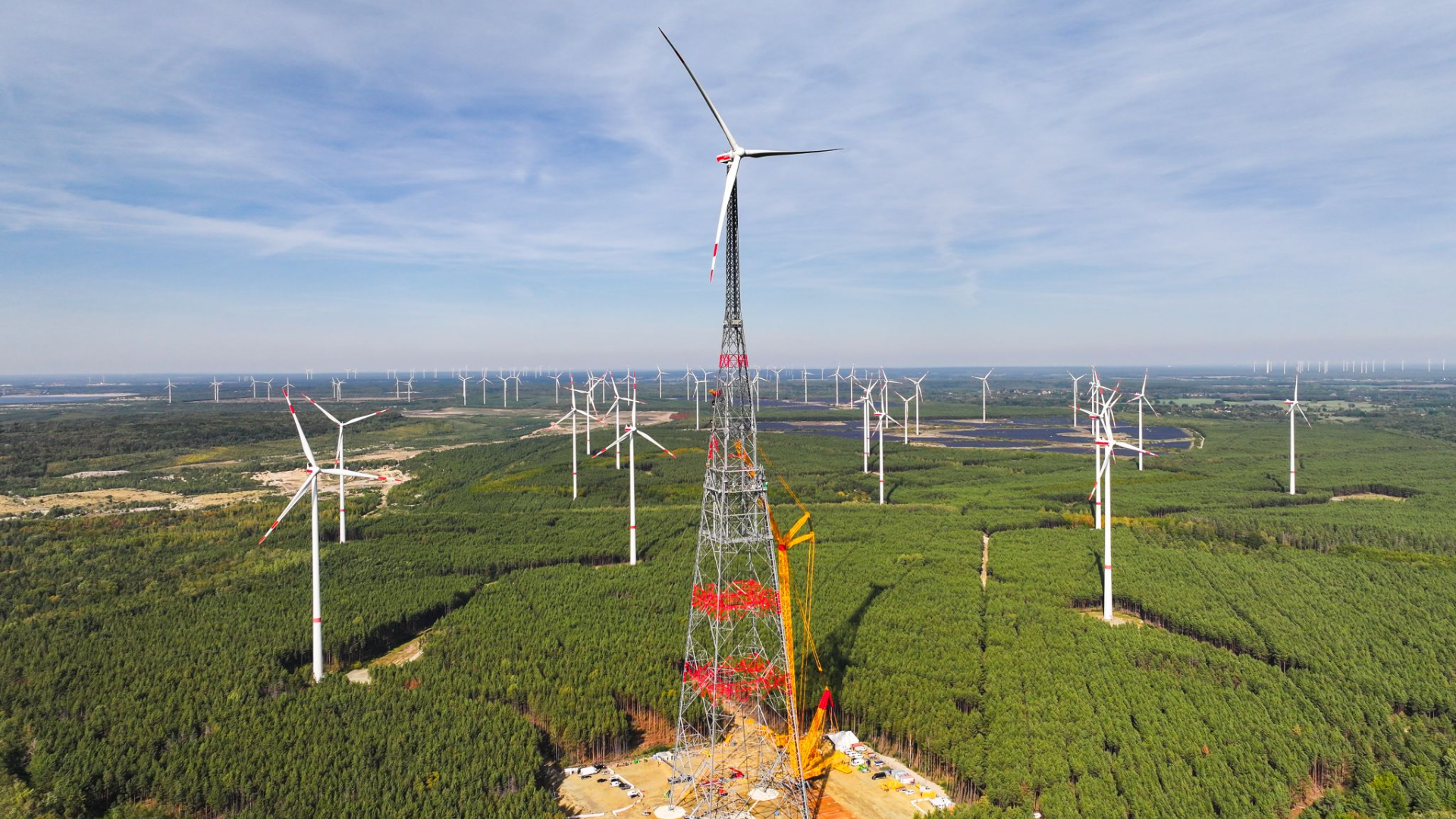
A wind turbine standing nearly 1,200 feet tall has reached its full height in eastern Germany, creating a new approach to capturing wind energy at elevations where winds are stronger and more consistent.
Developed by German engineering company GICON for the Federal Agency for Disruptive Innovation, or SPRIND, the pilot turbine in Schipkau is designed to test whether going dramatically higher can produce substantially more electricity from the same amount of wind infrastructure.
The structure reaches 1,197 feet, including its blades, making it Germany’s second-tallest structure after Berlin’s TV tower. GICON says the design could eventually generate roughly twice as much electricity as a conventional turbine with the same rotor diameter, although that estimate still needs to be demonstrated in operation.
The main idea behind GICON’s design is to go where the wind is better. Wind speeds generally increase with altitude, while higher elevations can also provide more consistent wind conditions. Hence, a turbine operating hundreds of meters above the ground has access to a larger and potentially more reliable energy resource than a conventional turbine.
The Schipkau pilot has a rated capacity of 3.8 megawatts, while future versions are expected to exceed 7 MW. The company’s projected doubling in energy output refers to electricity generated over time, rather than the turbine’s maximum rated power.
Reaching that altitude, however, required GICON to rethink how such a turbine could be constructed. Instead of using a conventional crane capable of reaching the top of the tower, the company used a telescoping tower design.
Source link





