This article has been reviewed according to Science X's editorial process and policies. Editors have highlighted the following attributes while ensuring the content's credibility:
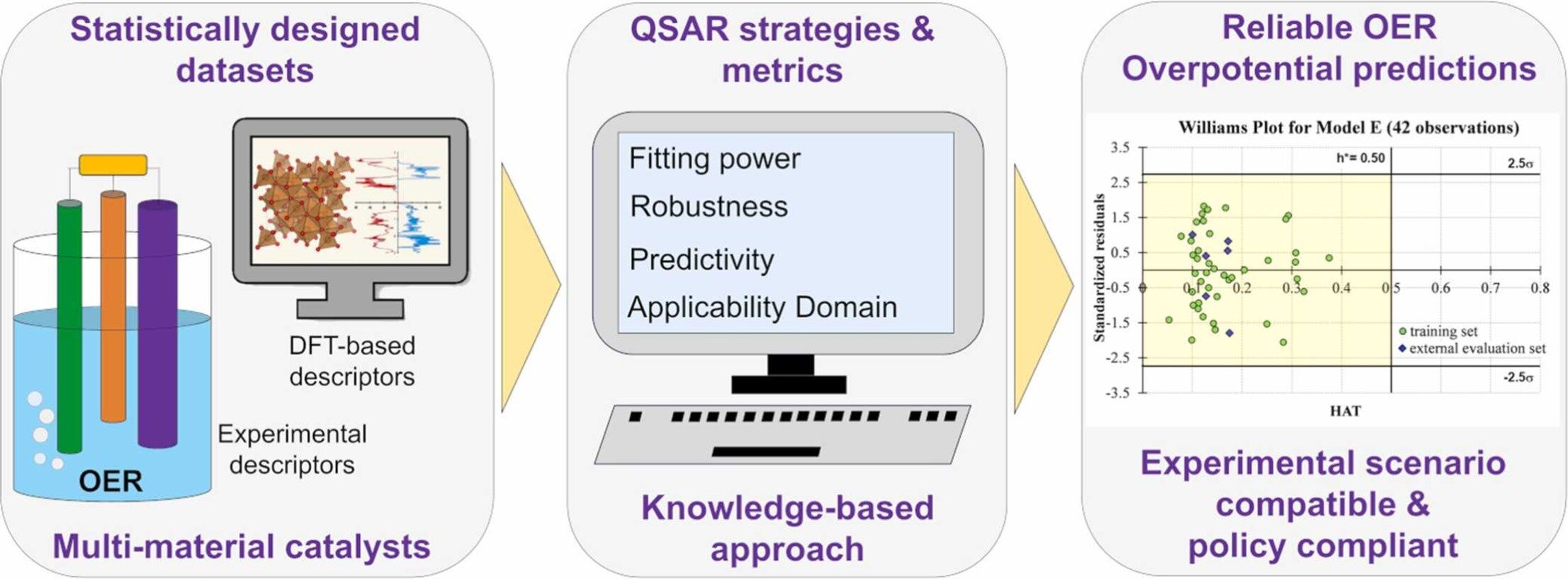
Green hydrogen is expected to play a central role in the transition to clean energy, but producing it efficiently requires the discovery of better catalysts. To help speed up this search, a team of researchers has introduced an innovative predictive framework that brings together for the first time catalyst science and quantitative structure-activity relationship ((Q)SAR) methodologies, a powerful approach widely used in fields such as toxicology, environmental science and drug development.
Drawing on experimental data reported in the scientific literature and advanced computational modeling, the team led by Dr. Chiara Biz (MagnetoCat SL, Spain) and Dr. Mauro Fianchini (University of Alicante, Spain) developed predictive models capable of estimating the experimental overpotential, a key indicator of catalyst efficiency. Their work is published in Materials Today Communications.
Using the oxygen evolution reaction as a model system, the models can reliably predict the performance of materials that have not yet been fully tested experimentally. This innovative capability could help researchers identify the most promising candidates at an early stage, significantly reducing the need for time-consuming and costly laboratory testing.
Significantly, the proposed predictive framework also complies with internationally recognized OECD guidelines for model validation, increasing the transparency, reliability and policy relevance of its predictions. While further efforts are underway to expand and refine the models, the study demonstrates how robust, reliable and policy-aligned predictive tools can support the digitalization of catalysis and speed up the development of next-generation clean energy technologies.
Source link