

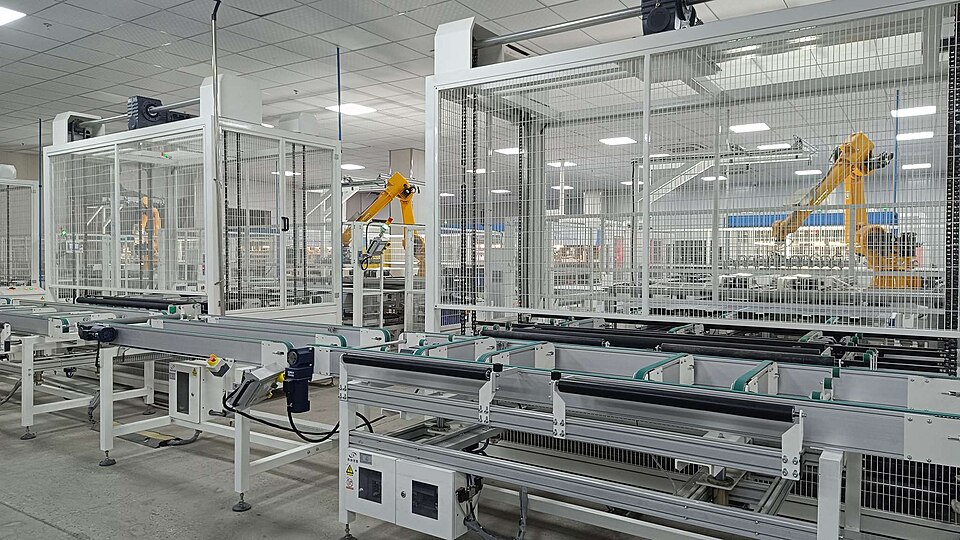
The European Union should expand domestic solar module manufacturing capacity to 30 GW and achieve factory utilization rates above 90% by 2030 to strengthen its supply security, according to a new study from Austria’s Technische Universität Wien.
The researchers examined how the EU could balance module procurement costs, geopolitical risks and supplier concentration through different sourcing strategies, with the analysis identifying Vietnam, Thailand and Malaysia as potential alternative suppliers to reduce dependence on China.
The team modeled EU module production capacity at 22 GW in 2024 and 25 GW in 2030 under its baseline assumptions, with maximum utilization rates of 50% and 85%, respectively. A Monte Carlo simulation explored capacity values between 20 GW and 30 GW and utilization rates ranging from 80% to 100%.
“We assume the following manufacturing cost shares of total EU module costs: labor 9%, R&D and overheads 6%, operating margin 4%, depreciation 3%, electricity 2%, and maintenance 1%,” corresponding author Helen Anais Fischer told pv magazine. “Electricity prices and capital expenditure are reflected in these cost shares. The remaining costs are component costs, which the model determines endogenously based on the country of supply.”
The researchers also incorporated technological learning, assuming a cost reduction of 24.9% for every doubling of global production capacity. Under the model’s projected capacity growth, this translates into a cost reduction of approximately 5.5% for modules, components and EU manufacturing by 2030. Nevertheless, lower manufacturing costs alone are unlikely to eliminate Europe’s competitiveness gap with Chinese suppliers.
Asked whether production subsidies could improve the economic viability of domestic manufacturing, Fischer clarified that the study does not explicitly simulate subsidy schemes.
Source link





