This article has been reviewed according to Science X's editorial process and policies. Editors have highlighted the following attributes while ensuring the content's credibility:
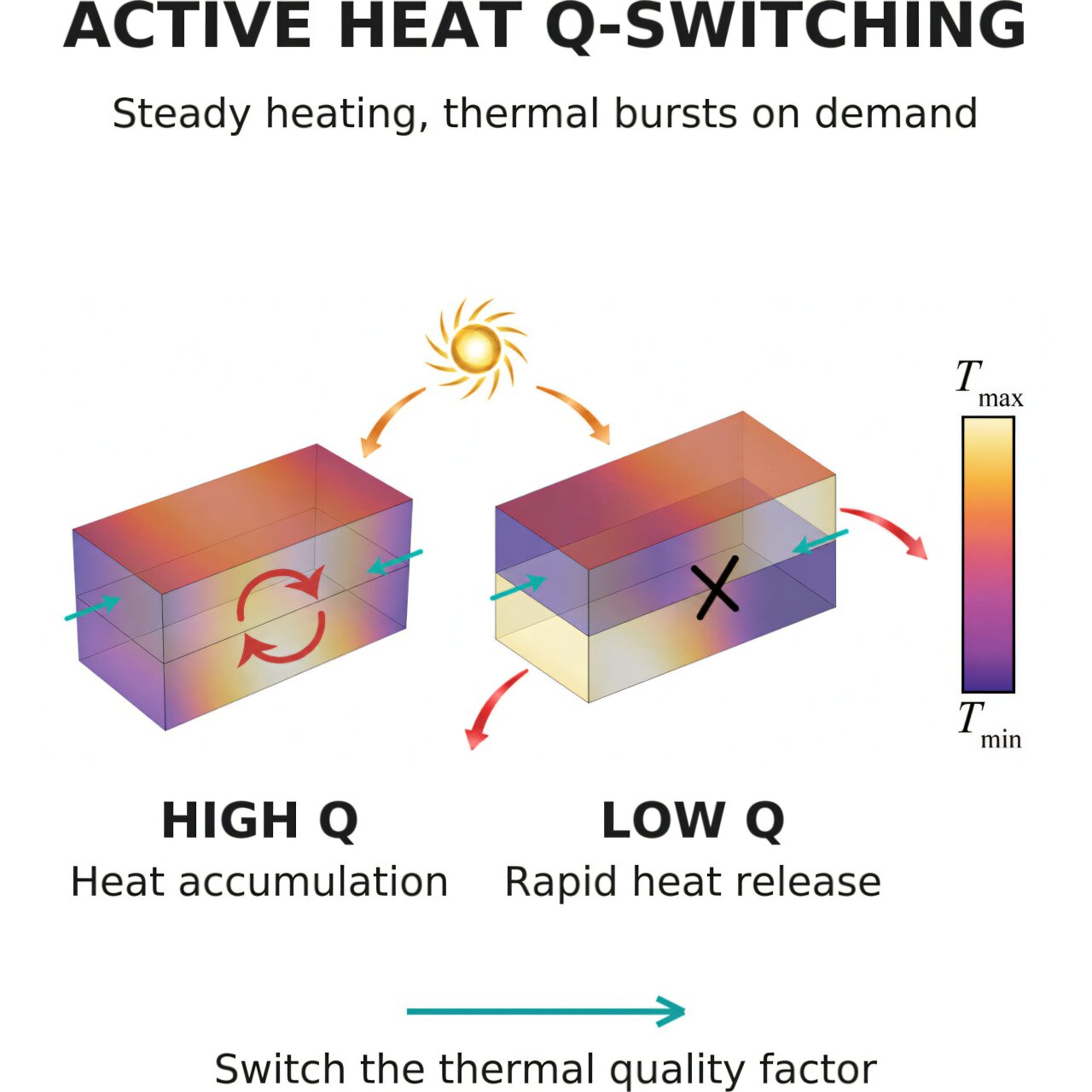
When a process needs a burst of heat, a steady supply may not be enough. Storing thermal energy and delivering it quickly are challenges for applications such as sterilization, cleaning or starting up distillation systems. To solve the problem, Rice University engineers turned to laser physics. By applying optics principles to heat transport in fluids, their new system accumulates heat and releases it on demand.
Published in Cell Reports Physical Science, the method, called active heat Q-switching, acts like an active heat dam. It uses two thermally connected channels carrying liquid in opposite directions to retain thermal energy, then release it in a pulse.
"The connection to pulsed lasers is the ability to control energy storage and release. In our thermal system, we do that by controlling how moving fluids exchange and carry heat," said Alessandro Alabastri, assistant professor of electrical and computer engineering and corresponding author of the study who coordinated the research.
In laser physics, "Q" stands for quality factor, a measure of how well an optical resonator retains energy. Q-switched lasers store energy in their amplifying material and release it as a short, intense light pulse. The Rice team adapted the broader principle of controlled storage and release to thermal energy.
"Imagine humming steadily into a room where sound keeps bouncing back and forth, building up energy," Alabastri said.
"If you could suddenly open a big door, that accumulated sound would escape in a brief, powerful burst.
Source link