This article has been reviewed according to Science X's editorial process and policies. Editors have highlighted the following attributes while ensuring the content's credibility:
Tin is able to exchange four electrons as it changes between dissolved ions and solid metal, but acidic tin batteries commonly use only a two-electron reaction, leaving half that potential charge out of reach. Now, researchers in China have shown that changing the liquid around the tin could capture that extra capacity.
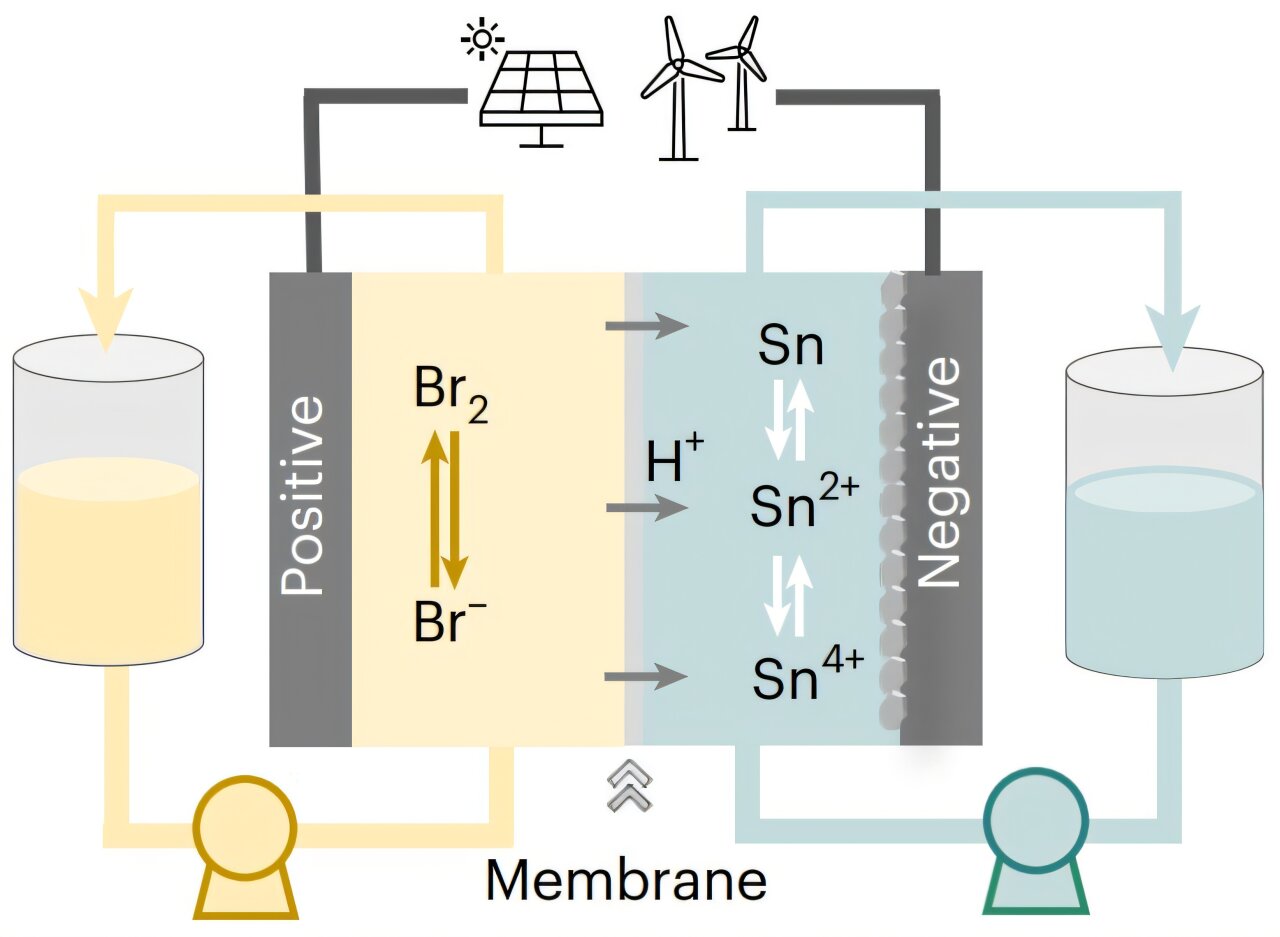
Adding iodide ions to a chloride-based solution helped a stubborn reaction run in both directions, allowing the transfer of all four electrons. The team demonstrated the chemistry in a tin–bromine flow battery and a 20-cell prototype that operated for more than 1,000 hours.
The study, published in Nature Chemistry, shows how the ions surrounding a battery material can determine how much of its capacity becomes available.
In a flow battery, liquid electrolytes circulate through cells where chemical reactions store and release electrical energy. More usable charge in those liquids can reduce the volume needed for storage. Tin's four-electron charging process has two steps. Dissolved tin ions first gain two electrons, then gain another two and become metal deposited on an electrode. Discharging reverses this sequence.
While earlier research has demonstrated four-electron tin chemistry in alkaline solutions, this new work tackles a different problem of making the first step readily reversible in an acidic electrolyte. The team, including Yue Ao and Congxin Xie of the Dalian Institute of Chemical Physics and Xiaoxiao Wang of Wuhan University, traced the difficulty to tin's immediate surroundings.
Source link