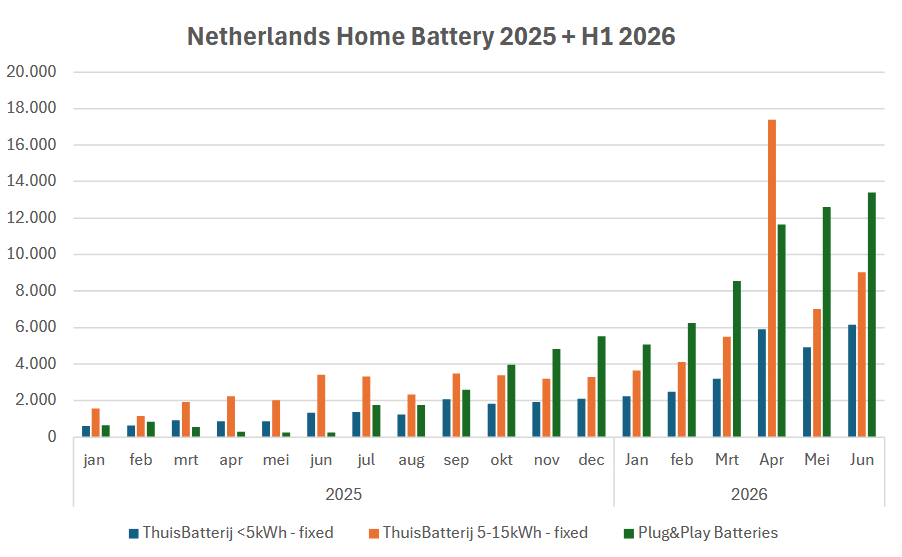
Sales of residential battery storage systems in the Netherlands have more than doubled over the past nine months ahead of the phaseout of the country’s net-metering scheme for residential PV at the end of this year, according to Sunergy Research, a Dutch energy supplier specializing in services for residential solar owners.
“Net metering will end on Jan. 1, and the market will change drastically for consumers,” Sunergy Research CEO Rolf Heynen told ESS news. “For many years, solar panels were easy to sell thanks to net metering and a very clear business case, with electricity prices stable at €0.21/kWh. Now, electricity prices have skyrocketed, and dynamic tariffs have made the business case more complex, alongside public discussions about the balancing market, variable grid tariffs starting in 2029, and home batteries.”
“With compensation for electricity exports expected to fall sharply, maximizing self-consumption is becoming increasingly important,” Heynen said. “Today, the average Dutch household consumes just 30% of the solar electricity it generates, exporting the remaining 70% to the grid. A home battery can dramatically reverse that balance, potentially increasing self-consumption to around 70%.”
Sunergy Research also reported that installations of small home batteries with capacities of up to 5 kWh were more than four times higher in September than in January, while installations of larger systems, ranging from 5 kWh to 15 kWh, nearly tripled over the same period.
The company’s data also show that installations of plug-in batteries, a relatively new segment of the Dutch energy storage market, have more than doubled in nine months, making them the largest category in the residential battery market.
Source link