

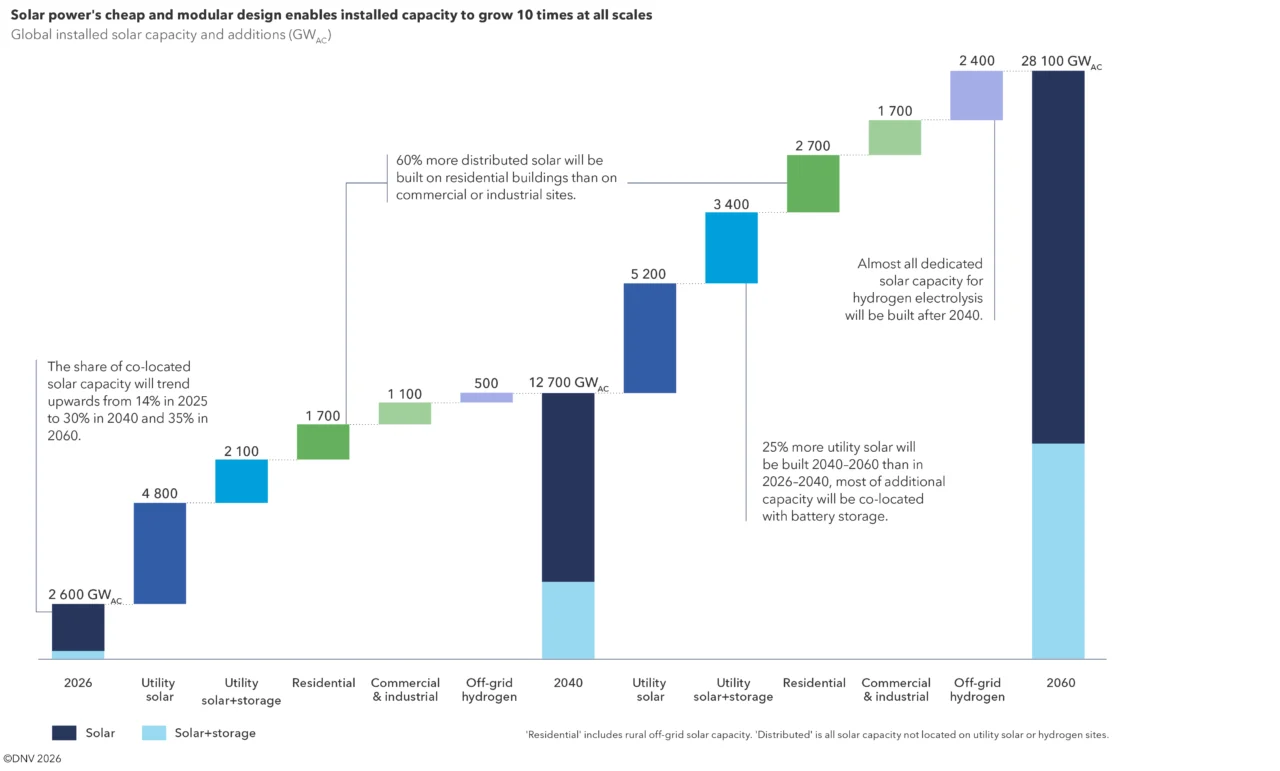
The number is set to double by 2030 and be ten times greater by the late 2050s, before reaching 28.1TW in 2060. Every region except Northeast Eurasia will generate more than 40% of its electricity from solar power.
Despite an accelerated growth in the past two decades, DNV expects annual solar PV additions to peak in 2026 and remain stable for several years. According to DNV, this is due to the fact that both Europe and Greater China, the two regions with the highest existing capacity, are facing significant solar curtailment and grid constraints.
This is prompting an increase in the co-location of solar PV with battery storage and standalone storage in both regions. Between 2024 and 2035, the share of annual co-located installations will grow from 25% to 40% in Europe and from 22% to 40% in Greater China.
Moreover, the share of co-located solar capacity is expected to increase their share from 14% in 2025 to 30% in 2040 and 35% in 2060, as shown in the chart below.
The share of rooftop solar installations – both residential and commercial and industrial (C&I) – is set to remain stable at the current level of 40%.
Annual investments in solar PV over the next ten years are forecast to more than double, from US$240 billion per year during 2016-2025 to US$600 billion per year during 2026-2035. This represents double the yearly investment in wind power during the same period.
Data from DNV’s report show that it forecasts 5,769GW of cumulative installed utility-scale solar PV globally in 2040.
Source link





