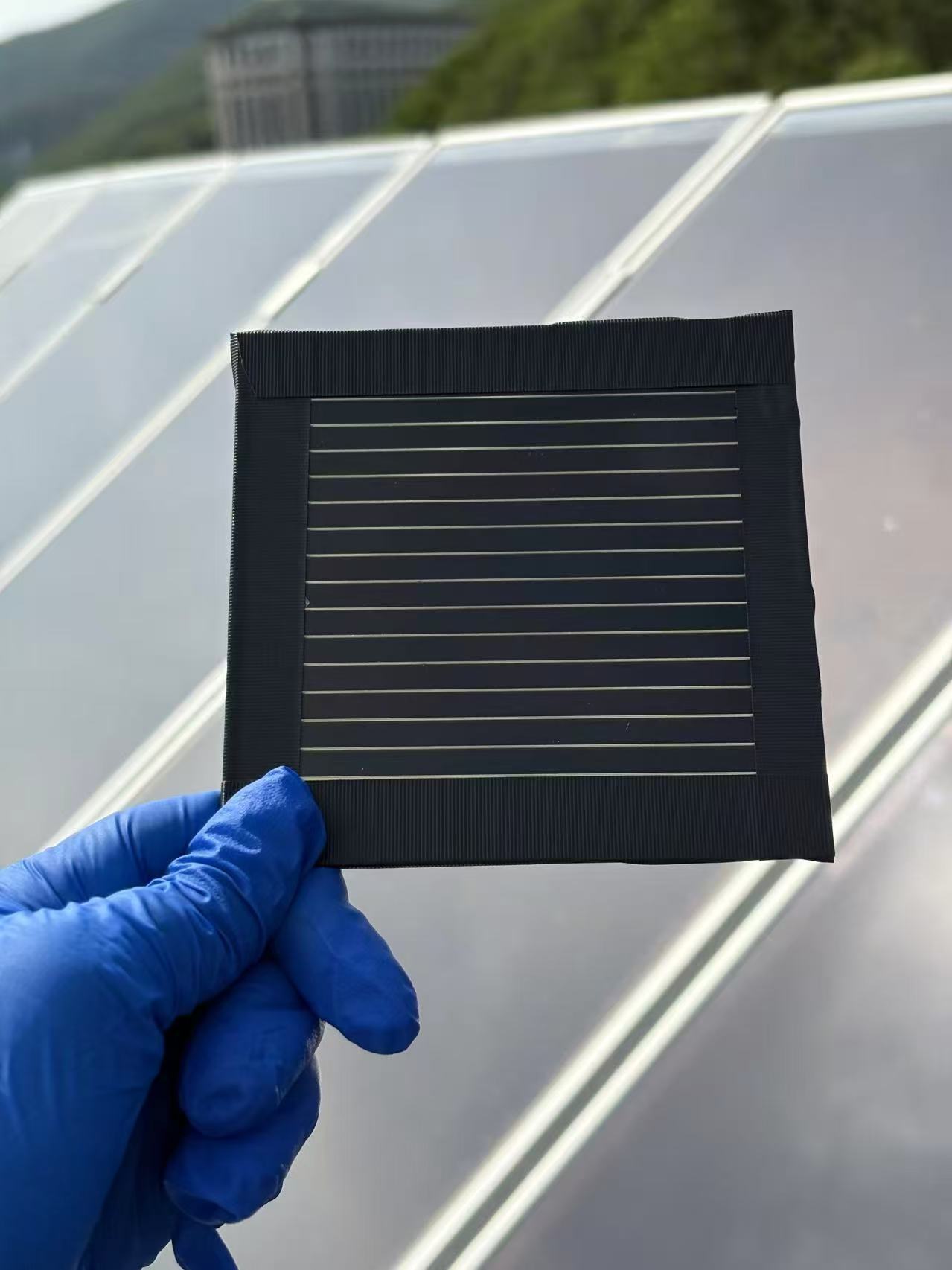
A group of researchers from the Chinese Academy of Sciences (CAS) and Dalian Jiaotong University have fabricated a small-sized solar module based on a perovskite material that doesn’t contain methylammonium (MA) molecules. These molecules have intrinsic thermal instability and contribute to increasing the typical thermal instability of perovskite PV devices.
MA negatively affects the stability of perovskite solar cells primarily because of its intrinsic thermal and chemical instability. At elevated temperatures, MA-containing perovskites such as MAPbI₃ can undergo decomposition, releasing volatile species such as methylamine (CH₃NH₂) and hydrogen iodide (HI). This promotes the degradation of the perovskite crystal structure and the formation of lead iodide (PbI₂), leading to increased defect density, reduced charge-carrier performance, and ultimately lower photovoltaic efficiency.
“We developed a reliable fabrication process for uniform, high-efficiency, methylammonium-free perovskite solar modules using slot-die coating under ambient conditions,” corresponding author Zhihua Zhang told pv magazine. “Slot-die coating is a highly attractive technique for the large-scale manufacturing of perovskite solar cells, combining efficient material utilization with seamless integration into continuous roll-to-roll production processes.”
Unlike conventional spin coating, slot-die coating enables controlled deposition of perovskite precursor inks over large substrates, facilitating the formation of uniform thin films with minimal material waste. However, achieving homogeneous film coverage and controlled crystallization remains challenging, particularly when transitioning from laboratory-scale devices to large-area modules.
Against this backdrop, the researchers used a combined additive (CA) strategy based on rubidium thiocyanate (RbSCN) and formamidinium thiocyanate (FASCN) to control how perovskite crystals form and evolve during deposition.
Source link