

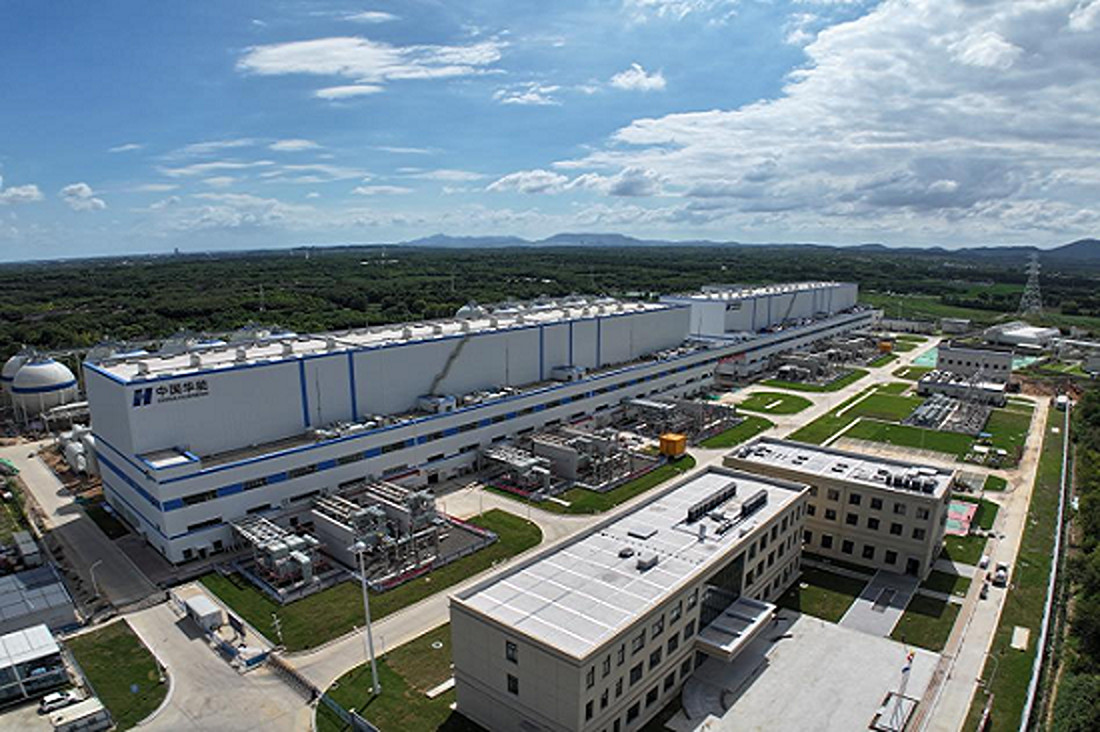
China Huaneng’s 700 MW Jintan salt-cavern compressed air energy storage (CAES) project has completed full-system startup of its two generating units in Changzhou, Jiangsu province.
The milestone was reached on Sept. 12, with both 350 MW units undergoing integrated startup testing under operating conditions. At 700 MW, the second phase of the Jintan project has the largest installed power capacity of any salt-cavern CAES facility currently reported worldwide. The project will now proceed with pre-grid-connection tests and system commissioning.
The plant uses four underground salt caverns at depths of around 1,000 meters, with total gas-storage volume of about 1.2 million cubic meters. Electricity is used to compress air to pressures exceeding 130 atmospheres during charging, while heat generated during compression is captured and stored. During discharge, the stored air is reheated and expanded through turbines without burning natural gas.
A full charging cycle stores about 2.8 GWh of electricity. Project documents describe an approximately eight-hour charging period and four hours of rated power generation, with more than 70% round-trip energy conversion efficiency. The facility is expected to complete around 330 charge-discharge cycles annually and generate about 924 GWh per year.
The second phase represents a major scale-up from the 60 MW/300 MWh first phase commissioned in 2022. Its compression system uses a dual-line, four-stage architecture to handle substantially higher airflow, while each generating unit employs a 350 MW air turbine with three reheating stages and four expansion stages. 5 MPa and has a design efficiency of more than 93%.
Source link





