
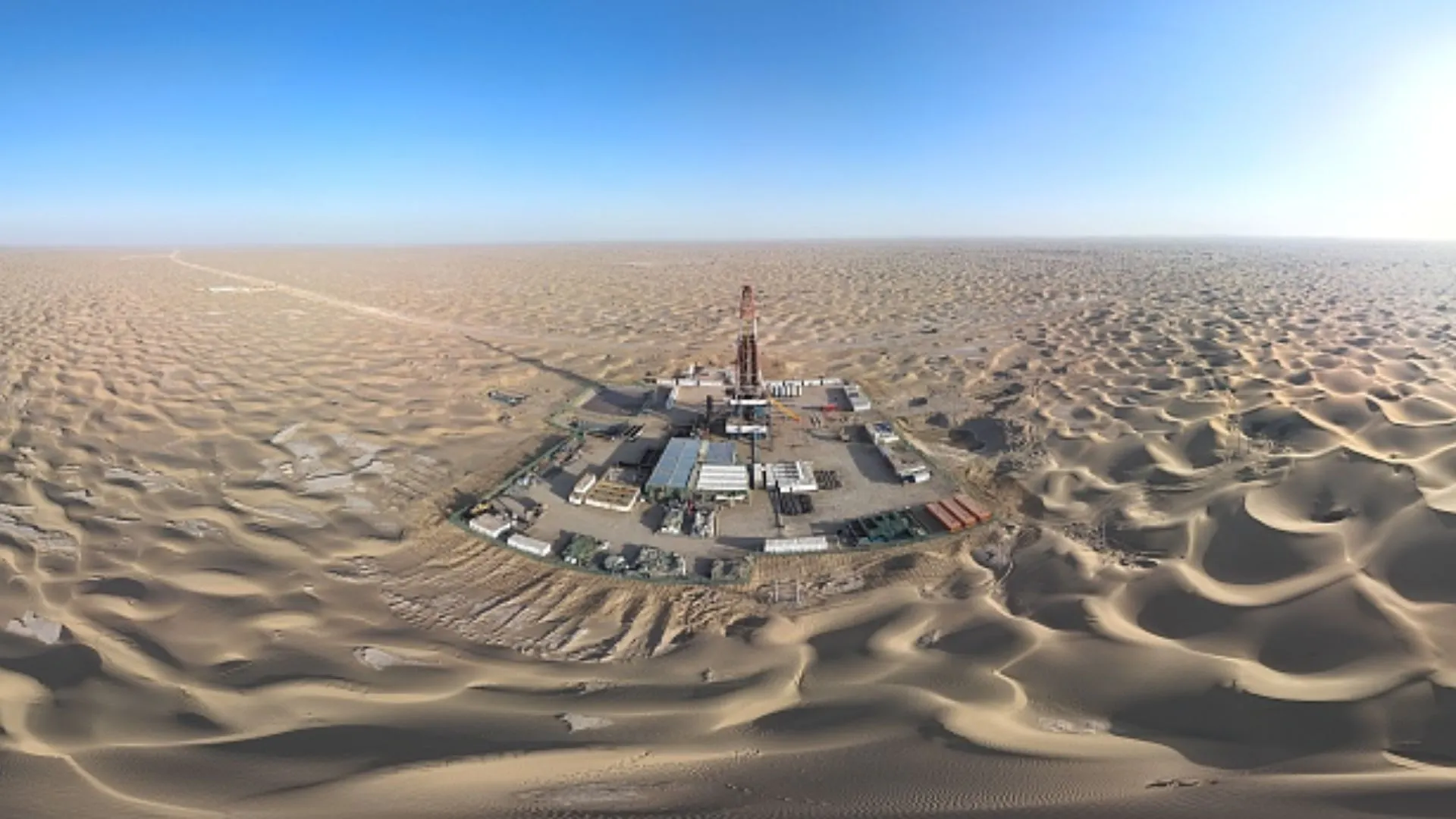
China’s largest desert oilfield has crossed a major production milestone after extracting more than 26 million metric tons (29.6 million U.S. tons) of oil and gas from formations buried deeper than 6,000 meters (19,685 feet) beneath the Taklimakan Desert.
China National Petroleum Corp. (CNPC), which operates the Fuman Oilfield in the Tarim Basin, announced the milestone on Monday. The development highlights the growing push to tap ultra-deep hydrocarbon resources in one of China’s most challenging oil-producing regions.
The latest breakthrough came at the Zhentan-1 well near the edge of the Taklimakan Desert. Engineers recently recovered rock cores from a depth of 8,080 meters (26,509 feet), providing samples of formations buried for about 500 million years.
It is the first time China has retrieved a core sample from deeper than 8,000 meters (26,247 feet) in the northwestern part of the Tarim Basin.
The Taklimakan Desert occupies much of the Tarim Basin in southern Xinjiang. The basin contains extensive sedimentary formations that have become a major target for China’s ultra-deep oil and gas exploration.
“With these precious rock cores, we can analyze and evaluate the hydrocarbon generation potential below 8,000 meters, including the thickness of the oil and gas layers and their maturity levels,” Xu Yanan, director of the Tarim Oilfield project at CNPC, as reported by the China Central Television (CCTV) News.
The Fuman Oilfield has now produced substantial volumes from its ultra-deep formations. 8 billion cubic feet) of natural gas.
Source link





