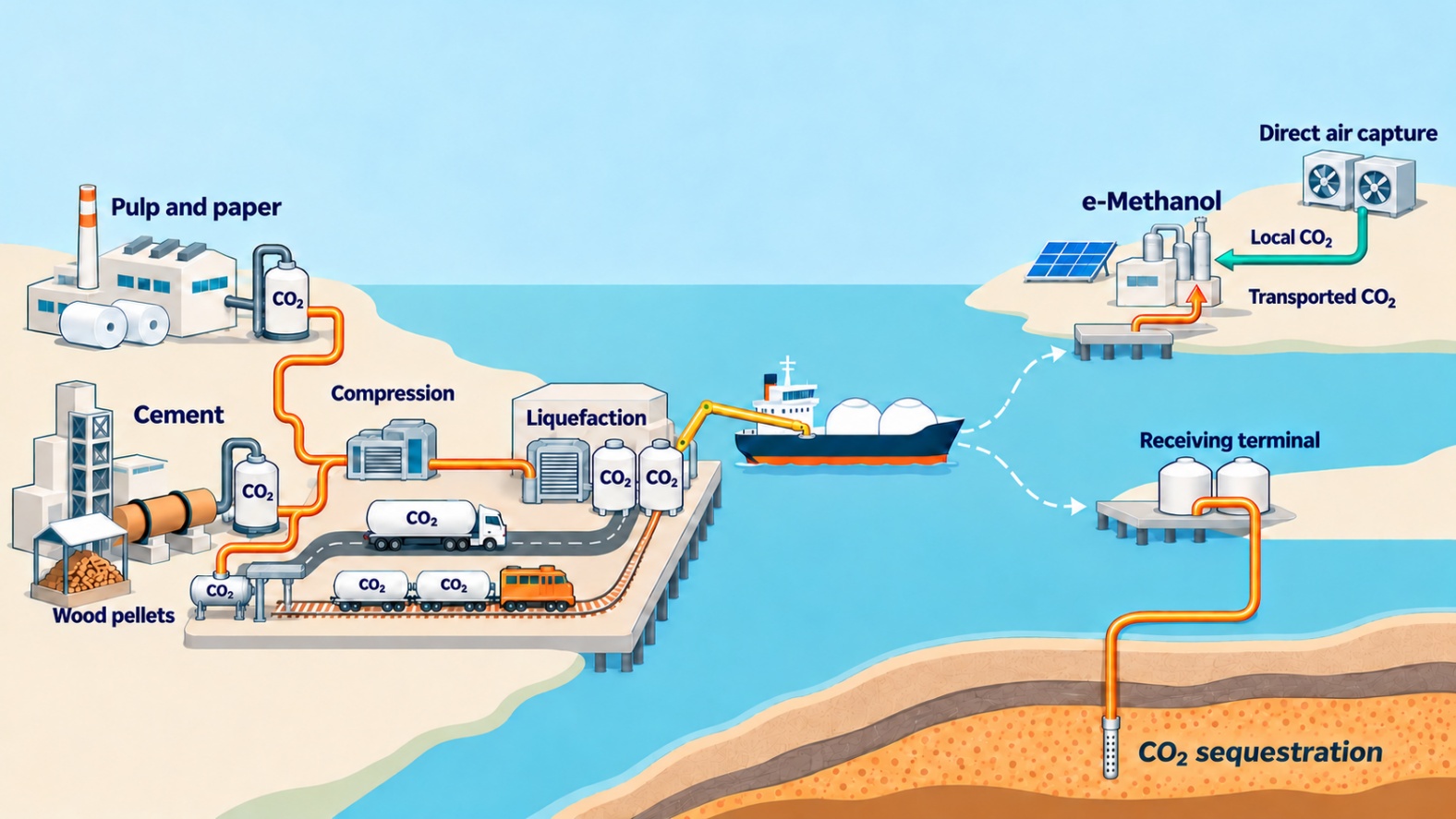
Producing fuels from captured CO2 requires large amounts of renewable electricity, yet major carbon sources and the best wind or solar sites are often far apart. This creates a supply chain dilemma: should e-fuel producers build facilities next to the carbon source, or transport the molecular CO2 or possibly biomass to regions where renewable electricity is lower in cost?
For e-methanol, produced with hydrogen from renewable electricity and reacted with CO2, the answer comes down to logistics. Recent modeling from LUT University reveals how to best combine these ingredients by comparing transport options, production locations, and alternative carbon sources. Three research articles are presented in more detail, focusing on relative infrastructure options, transport options for CO2 also in dependence of renewable energy resources, and transporting biomass instead of biogenic CO2.
Finland is a region rich in both wind energy and biogenic as well as industrial CO2 sources. Yet these resources are on the opposite sides of the country. In a comparison of transport options connecting Finnish pulp and paper mills with the best wind resources 370-590 km away, moving CO2 by pipeline results in the lowest methanol costs. Conversely, moving hydrogen or electricity from wind-rich regions directly to the CO2 source makes methanol 5-15% more expensive. Savings from producing hydrogen and methanol at sites with best renewable resources outweigh the cost of transporting CO2.
For longer distances, besides pipelines, shipping also opens access to sunnier regions with even lower renewable electricity costs.
Source link