This article has been reviewed according to Science X's editorial process and policies. Editors have highlighted the following attributes while ensuring the content's credibility:
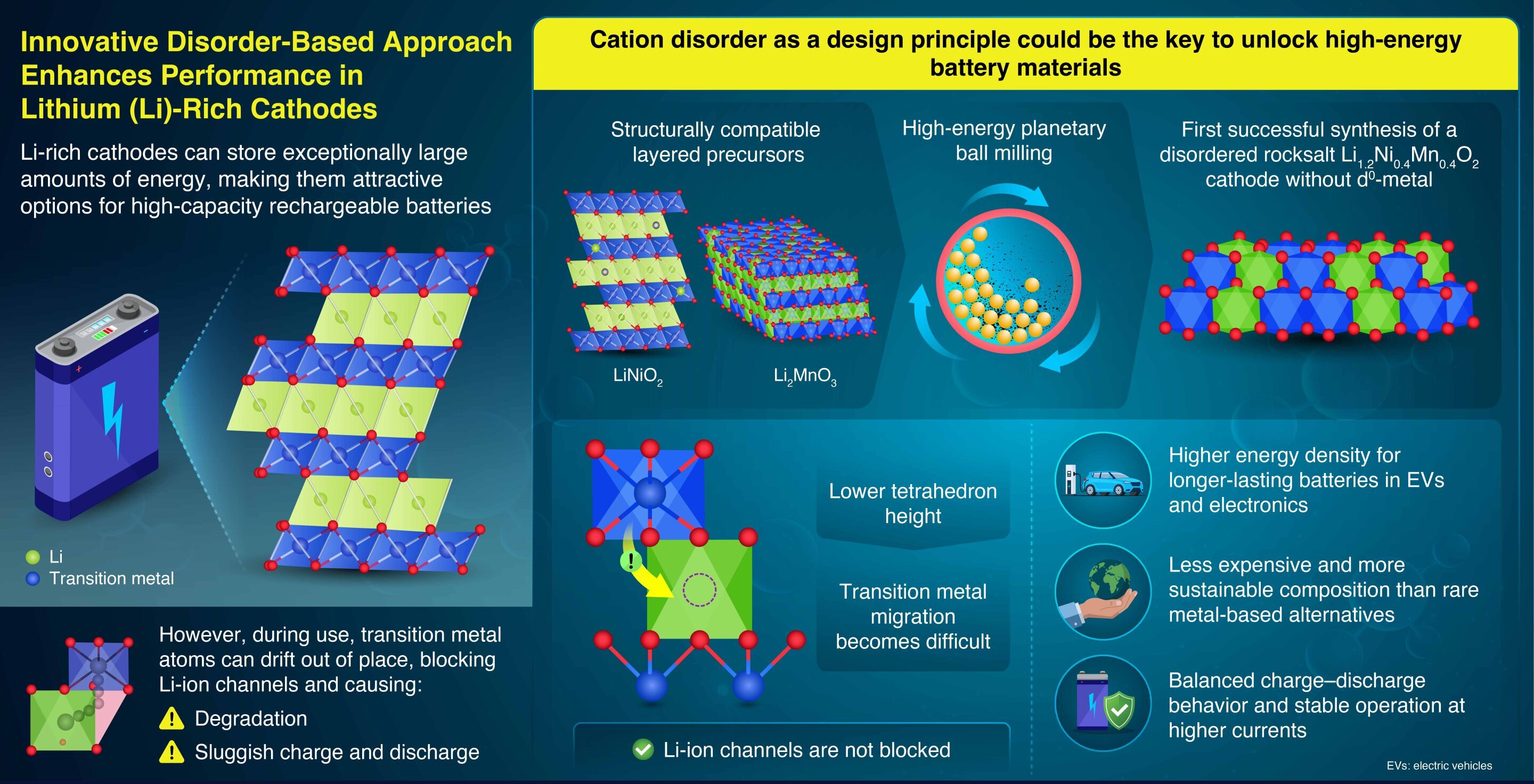
Lithium-rich cathode materials are promising candidates for next-generation batteries, as they can store considerably more charge than materials used today in electric vehicles and electronics.
Because the cathode's capacity is a major factor in how much energy a battery can hold, lithium-rich materials could eventually lead to batteries with higher energy density, enabling phones, laptops and electric vehicles to run longer on a single charge.
However, lithium-rich cathodes face a longstanding problem. During charging and discharging, transition-metal ions such as nickel and manganese can drift away from their original positions in the crystal structure. These migrating ions can obstruct the pathways that lithium ions need to travel through, slowing the movement of lithium and contributing to irreversible performance loss over repeated cycles.
Scientists have mostly tried to tackle this issue by preserving an orderly crystal structure in the cathode, assuming an orderly arrangement would give lithium a clearer path to move through. But what if the opposite approach was better?
In a recent study published in Energy Storage Materials, a research team led by professor Kyojin Ku of the Department of Materials Science and Engineering at Hanbat National University, Korea, explored this question by intentionally disrupting the atomic structure of a lithium-rich cathode.
₄O₂, a nickel-manganese composition that avoids expensive metals like cobalt. This particular composition normally forms a neatly layered structure, where lithium and transition-metal ions (nickel and manganese) sit in separate planes.
Source link