
This article has been reviewed according to Science X's editorial process and policies. Editors have highlighted the following attributes while ensuring the content's credibility:
Sodium batteries, which store and release electrical energy by moving sodium ions between their two electrodes, could be a more affordable alternative to lithium-based batteries. This is because sodium is highly abundant on Earth and can be sourced from widely available raw materials.
Some energy researchers have also been exploring sodium batteries that are assembled without a sodium-metal anode, known as anode-free sodium batteries. In these batteries, sodium ions originating from the cathode (i.e., the positive electrode while the battery is discharging) gain electrons and deposit as sodium metal onto a thin metal current collector during charging, forming the anode.
This anode-free design could further reduce manufacturing costs, while also increasing the energy that sodium batteries can store relative to their weight. Despite their potential, anode-free sodium batteries have a limited supply of sodium, and the irreversible loss of sodium as they are charged and discharged can reduce their capacity and cycle life.
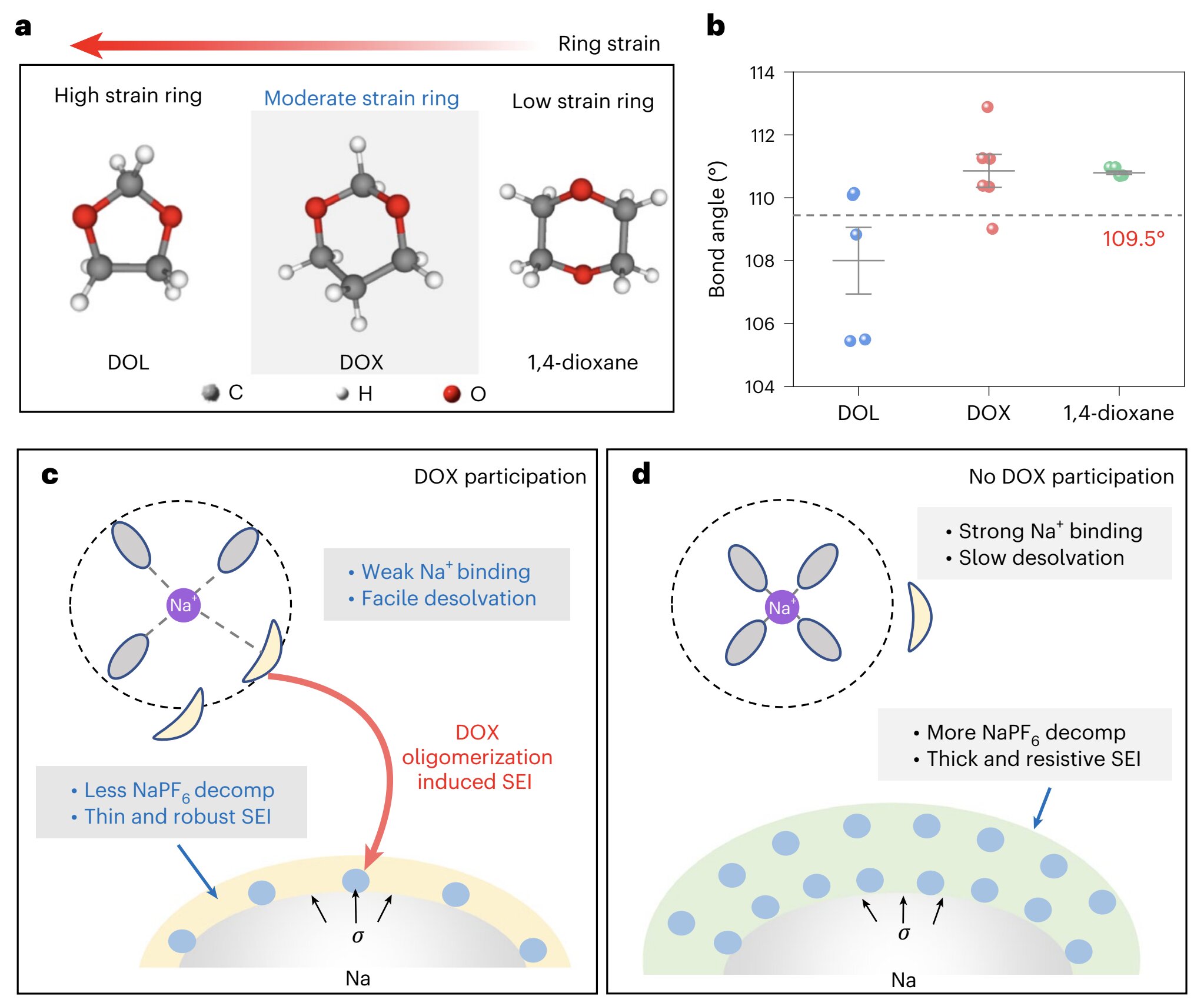
Researchers at Xi'an Jiaotong University, the Chinese Academy of Sciences and other institutions recently designed a new electrolyte for anode-free sodium batteries that incorporates the solvent 1,3-dioxane (DOX). The electrolyte, presented in a paper published in Nature Energy, was found to extend the lifespan of anode-free pouch cells, slowing down their loss of capacity.
"Our group began working on sodium-ion batteries in 2022, initially focusing on electrolyte design for conventional batteries using hard-carbon anodes," Weijiang Xue, senior author of the paper, told Tech Xplore.
Source link





