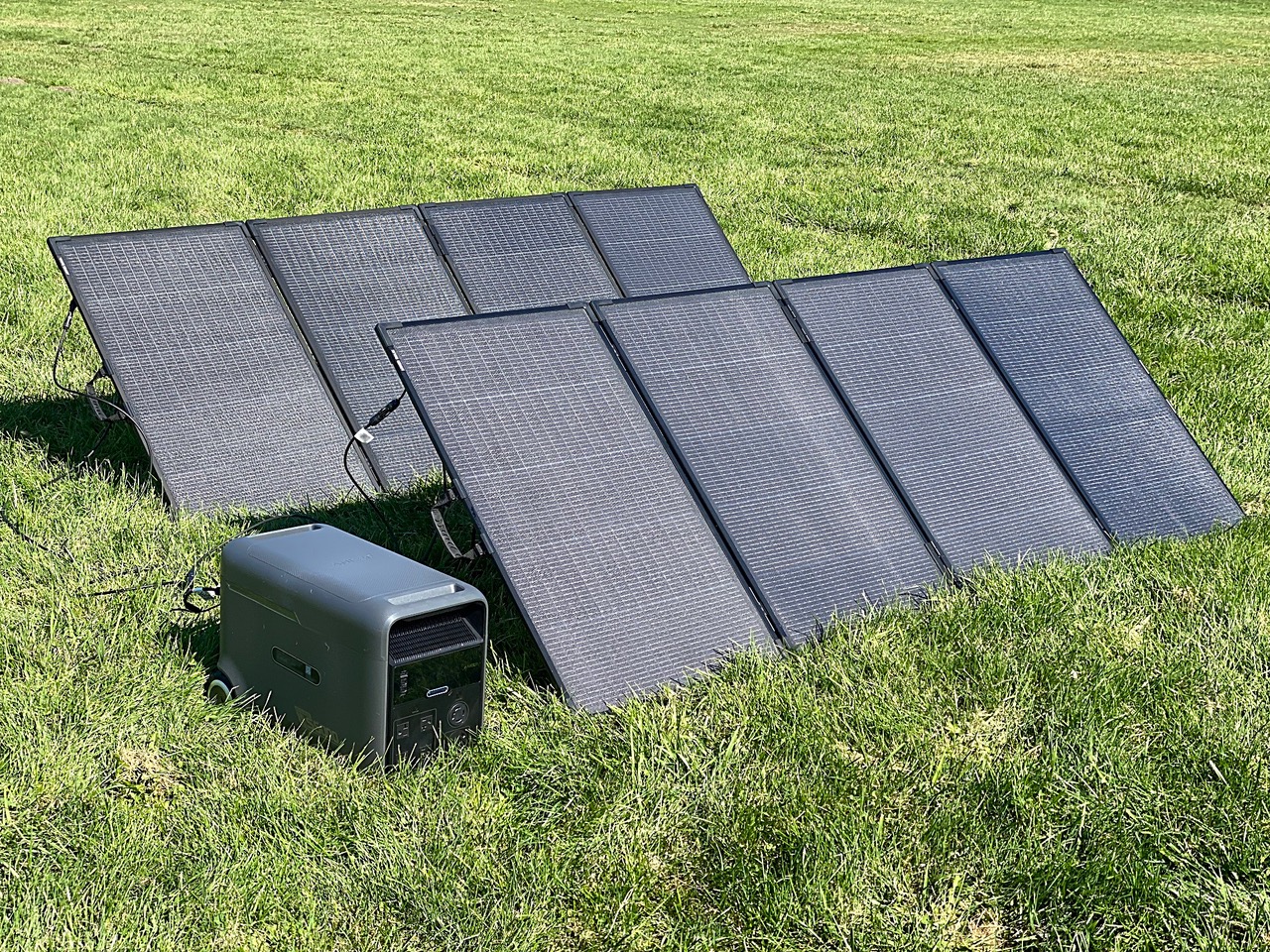
Anker announced the S5000 on October 9. I tested a pre-release unit in Northern California, focusing on charging, usable capacity, idle consumption, portability, and backup during a multi-day power outage.
Read on to see how my father-in-law’s legendary homemade pasta sauce survived a real three-day outage, and what my mother-in-law said!
(Previously, I also tested out the Anker Solix E10 back in May, a whole-home backup, and the Anker Solix S2000 as well.)
The S5000 is a wheeled power station with 5,024 Wh of LFP storage and a 4,500 W inverter that supplies both 120 V and 240 V.
According to Anker, the L14-30R keeps supplying 240 V while the S5000 charges from a 120 V outlet or generator. I didn’t test that.
The S5000 charges four ways: AC, solar, Anker’s Smart Generator, and a vehicle alternator. I tested AC and solar.
I ran two full 0–100% charges from a standard U.S. 120 V, 60 Hz outlet with an energy meter at the wall: one at the app’s 1,800 W maximum and one at 1,000 W. I didn’t test 240 V charging.
AC charging from a standard 120 V outlet. The AC input, on the rear next to the wheels, uses an E10-style locking connector, though the receptacle is specific to the S5000 and doesn’t take E10 cables.
43 kW for the last 50 minutes. That matches a footnote in Anker’s specs: at 120 V, the 1,800 W rate is limited to under three hours when current exceeds 12 A.
Source link