This article has been reviewed according to Science X's editorial process and policies. Editors have highlighted the following attributes while ensuring the content's credibility:
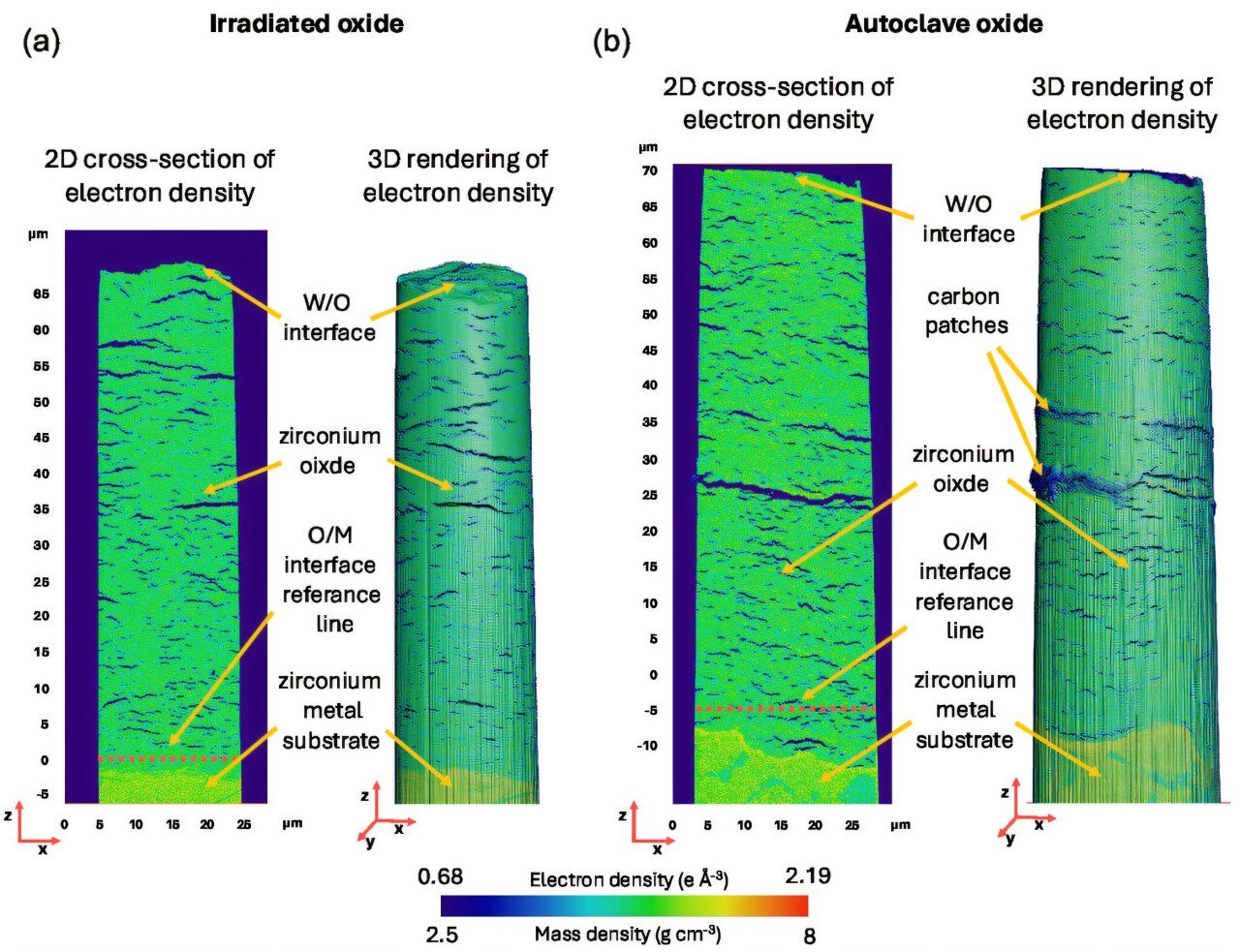
The cladding tubes of the fuel rods used in nuclear reactors must remain leak-tight—despite the risk of corrosion from the surrounding cooling water and despite the radiation they are exposed to during operation. It is therefore important to know how quickly corrosion layers form and how porous they are.
Researchers at the Paul Scherrer Institute PSI have now used a new technique to visualize these changes in the cladding material in three dimensions for the first time, achieving a resolution in the nanometer range.
Another distinguishing feature of their experiment is that the samples they examined were taken from cladding tubes that had actually been in service in a nuclear power plant. The tubes were able to withstand the stresses involved: They were still leak-tight.
The researchers have now published the results of their study in the journal Advanced Engineering Materials.
The new research was carried out in a collaboration between three PSI research centers: the Center for Nuclear Engineering and Sciences, the Center for Photon Science and the Center for Neutron and Muon Sciences.
At PSI's so-called Hot Laboratory—a unique facility for the analysis of highly radioactive materials—staff from the Center for Nuclear Engineering and Sciences used special precision saws in shielded hot cells to slice wafer-thin samples from the cladding tubes of spent fuel rods. They then shaped them into cylindrical samples using a focused ion beam.
Source link