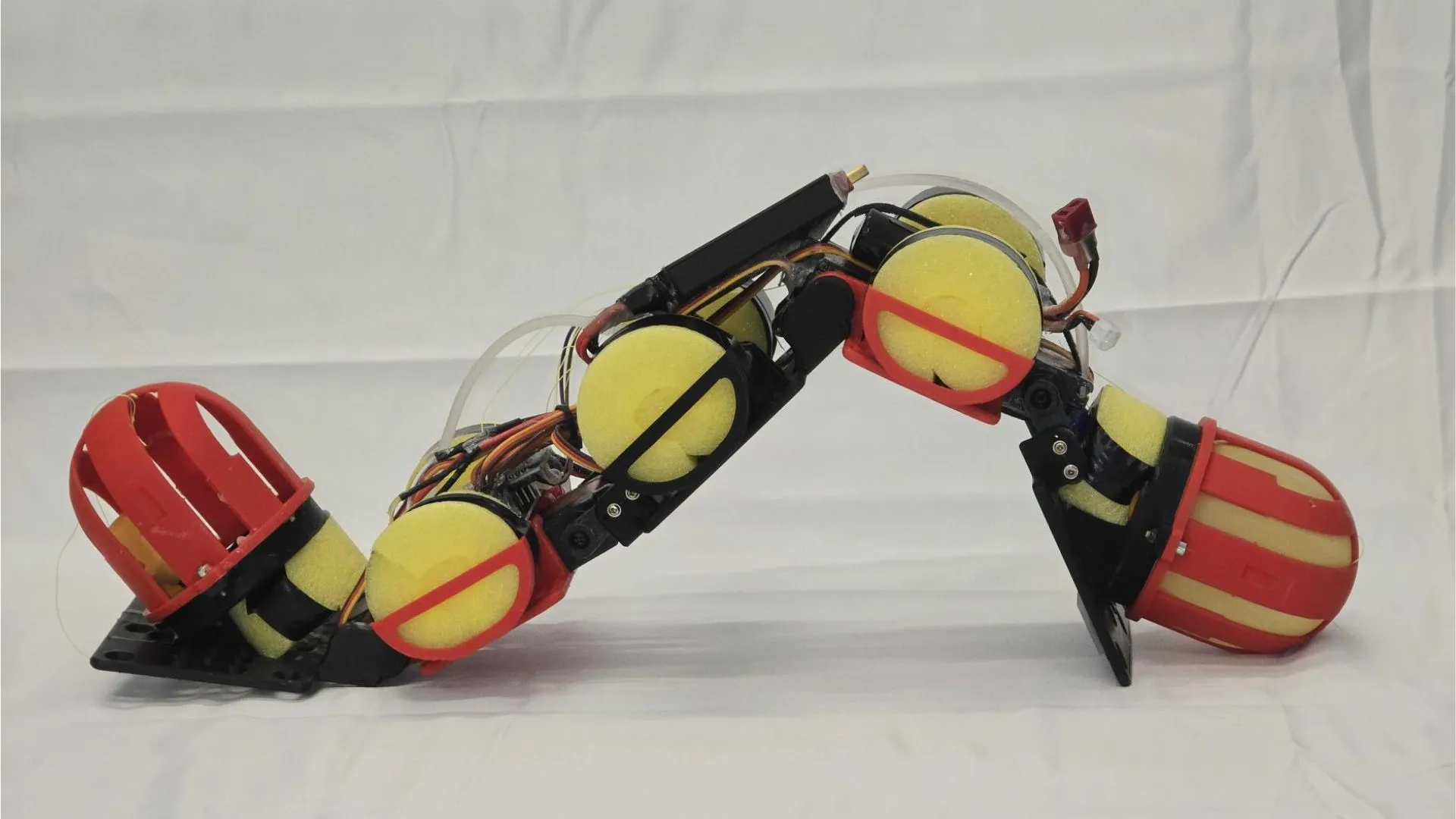
Researchers at New York University have developed a worm-like robot designed to navigate rugged coastal terrain. Called WorMa, the robot can move across rocks and slopes before entering and exiting water.
Its design is inspired by the way worms adapt their movement to changing environments. The researchers developed the robot to tackle terrain that can be difficult for conventional wheeled or legged machines.
Researchers at NYU’s Tandon School of Engineering developed WorMa, an amphibious, worm-like robot that changes how it moves across different terrain by shifting its weight.
Instead of switching between entirely different gaits or mechanically reconfiguring its body, the robot uses water as a movable ballast. A pump transfers water between tanks in its head and tail, allowing WorMa to redistribute its mass and adjust how it interacts with the ground or water.
WorMa is designed to handle transitions between surfaces that can challenge conventional robots. The five-link, four-joint robot is about 20 inches long (50 centimeters) long and weighs slightly more than 2.2 pounds (1 kilogram). Its body contains latex water balloons at the head and tail, while a pump located in the middle section moves about 10.6 ounces (about 300 grams) of water between them.
The technology relies on changing the robot’s center of mass rather than adding specialized mechanical components for each environment. Moving the water toward the head increases the force applied through the front contact points. This gives the robot greater traction when climbing sloped surfaces.
Source link