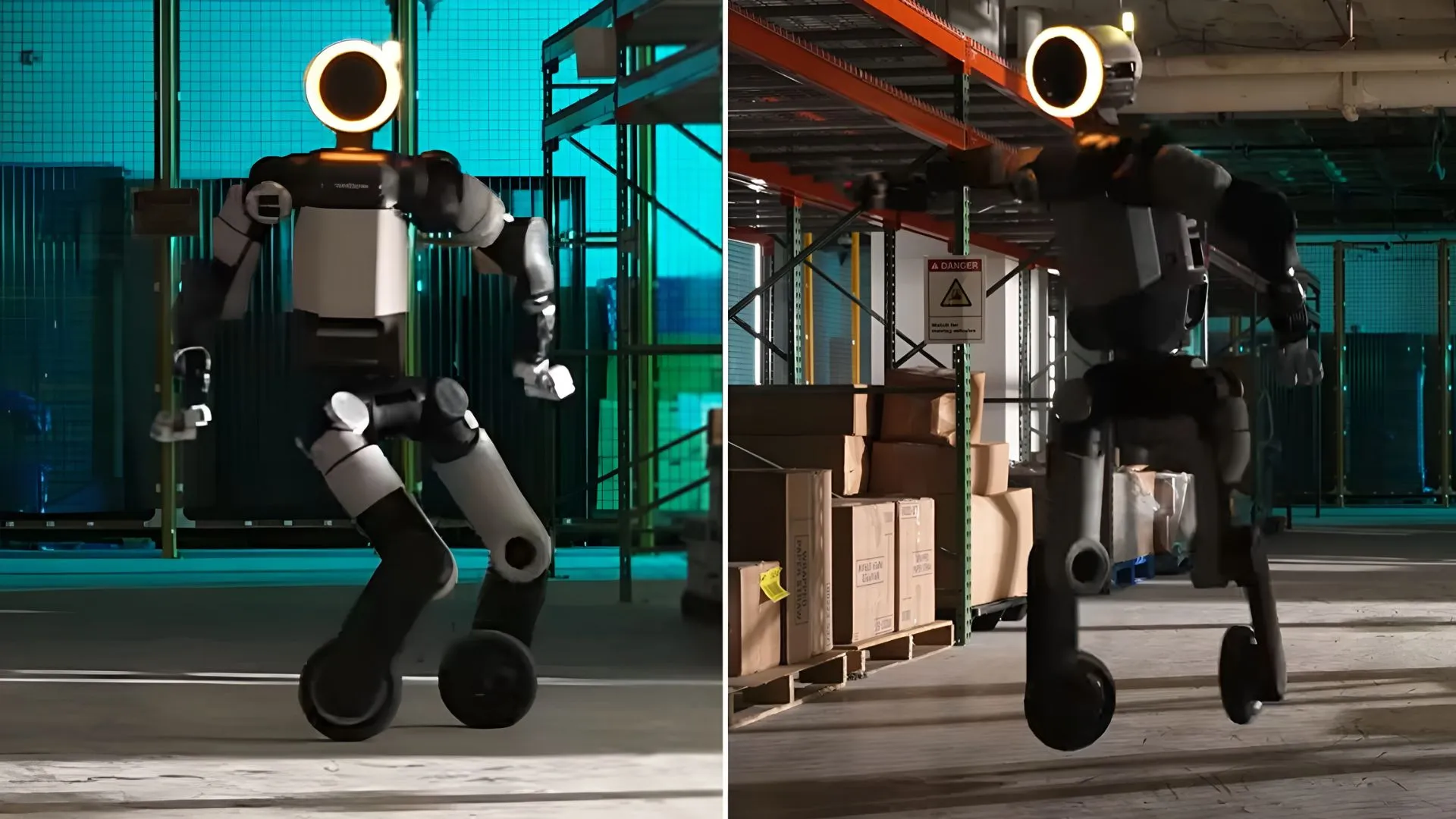
Boston Dynamics has given its Atlas humanoid robot an unusual upgrade: a pair of wheels replacing its feet. The experimental setup lets engineers test how the humanoid handles sustained high-speed movement and heavy loads. It also offers a demanding environment for testing the robot’s motors and machine-learning-based control systems.
The wheeled Atlas isn’t a planned commercial product. Boston Dynamics developed it as a research platform to investigate how accurately simulation-trained controllers can operate real hardware. The project also explores what happens when engineers push the robot’s actuators close to their physical limits.
The engineering behind the modification was surprisingly straightforward. Boston Dynamics attached standard electric scooter wheels to Atlas using a custom adapter. The adapter connects directly to the robot’s existing ankle actuators.
No other major hardware changes were necessary. Engineers also avoided rebuilding the robot’s software model from scratch. They simply replaced the simulated feet with wheels capable of continuous rotation.
That simplicity reflects Atlas’ modular hardware design. Boston Dynamics developed the humanoid with manufacturing scalability and easier maintenance in mind. The same design principles also made this experimental conversion relatively uncomplicated.
Wheels offered another advantage during testing. They forced the motors to deliver considerable torque while maintaining high rotational speeds. Every acceleration, turn, and stop placed sustained demands on the actuators.
The experiment also gave engineers an opportunity to explore reinforcement learning (RL). The technique trains a robot through repeated simulations, allowing its control system to discover effective movements.
However, transferring those learned behaviors to physical hardware presents a significant engineering challenge.
Source link