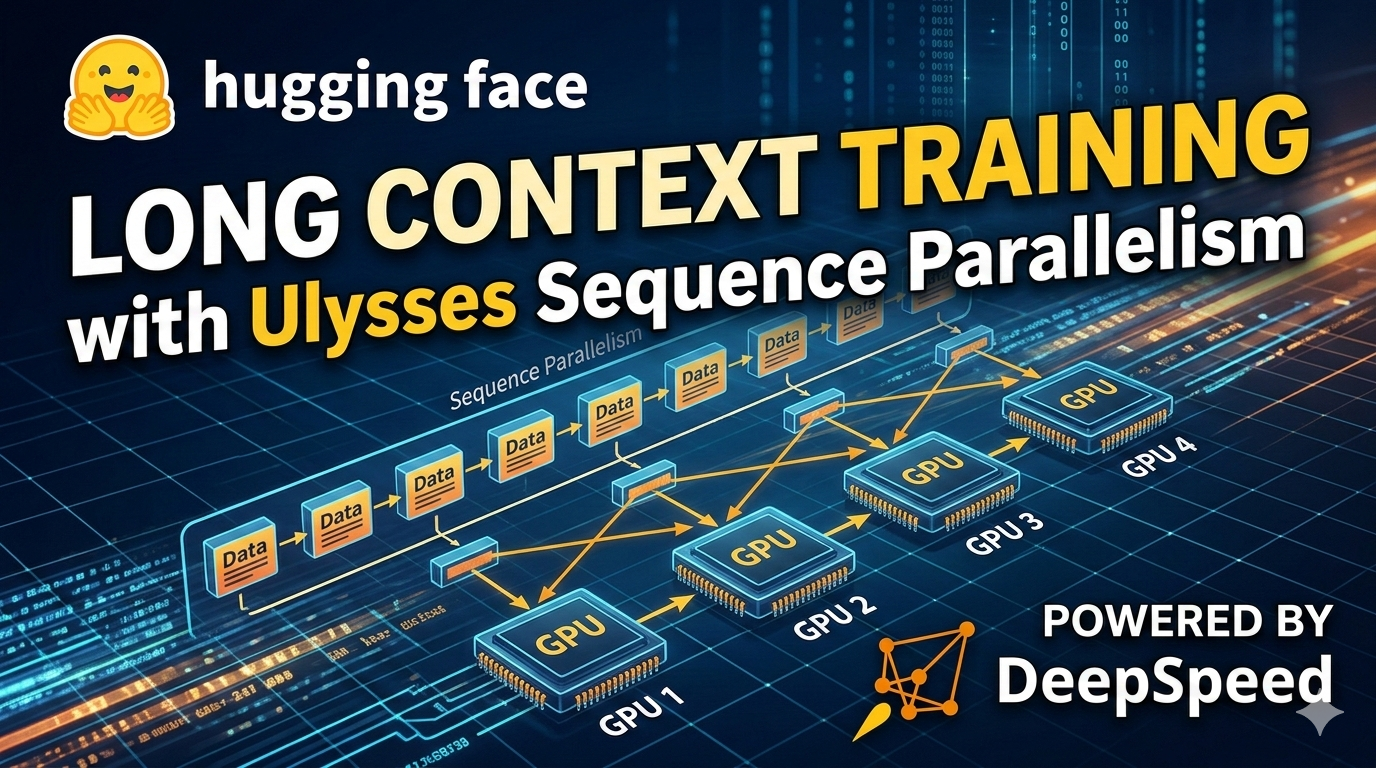
Ulysses Sequence Parallelism (part of the Arctic Long Sequence Training (ALST) protocol from Snowflake AI Research) provides an elegant solution by distributing the attention computation across multiple GPUs through attention head parallelism. In this post, we'll explore how Ulysses works and how it's been integrated across the Hugging Face ecosystem—from Accelerate to the Transformers Trainer and TRL's SFTTrainer.
The attention mechanism in transformers scales quadratically with sequence length. For a sequence of length , standard attention requires FLOPs and memory to compute and store the attention score matrix. Optimized implementations like FlashAttention reduce the memory to by tiling the computation and never materializing the full attention matrix—but the compute remains. For very long sequences (32k+ tokens), even with FlashAttention, training still pushes the limits of single-GPU memory.
Traditional data parallelism doesn't help here—each GPU still needs to process the full sequence inside the attention block. We need a way to split the sequence itself across multiple devices.
Ulysses Sequence Parallelism (SP), introduced in the DeepSpeed Ulysses paper, takes a clever approach: in addition to splitting on the sequence dimension, it also partitions the attention heads across GPUs.
Sequence Sharding : The input sequence is split along the sequence dimension across P P P GPUs.
Source link