This article has been reviewed according to Science X's editorial process and policies. Editors have highlighted the following attributes while ensuring the content's credibility:
Smartphones and computers process information by switching the current that flows inside semiconductors on and off. The gate electrode delivers the signal that controls this switching. Until now, gate electrodes have typically been made from metals whose electronic properties are fixed.
A KAIST-led joint research team has now built working semiconductor electrodes from a new material that combines metals and organic molecules. The study provides a basis for designing electrodes to meet the requirements of different semiconductors. It is also expected to support the development of low-power semiconductors that operate at lower voltages.
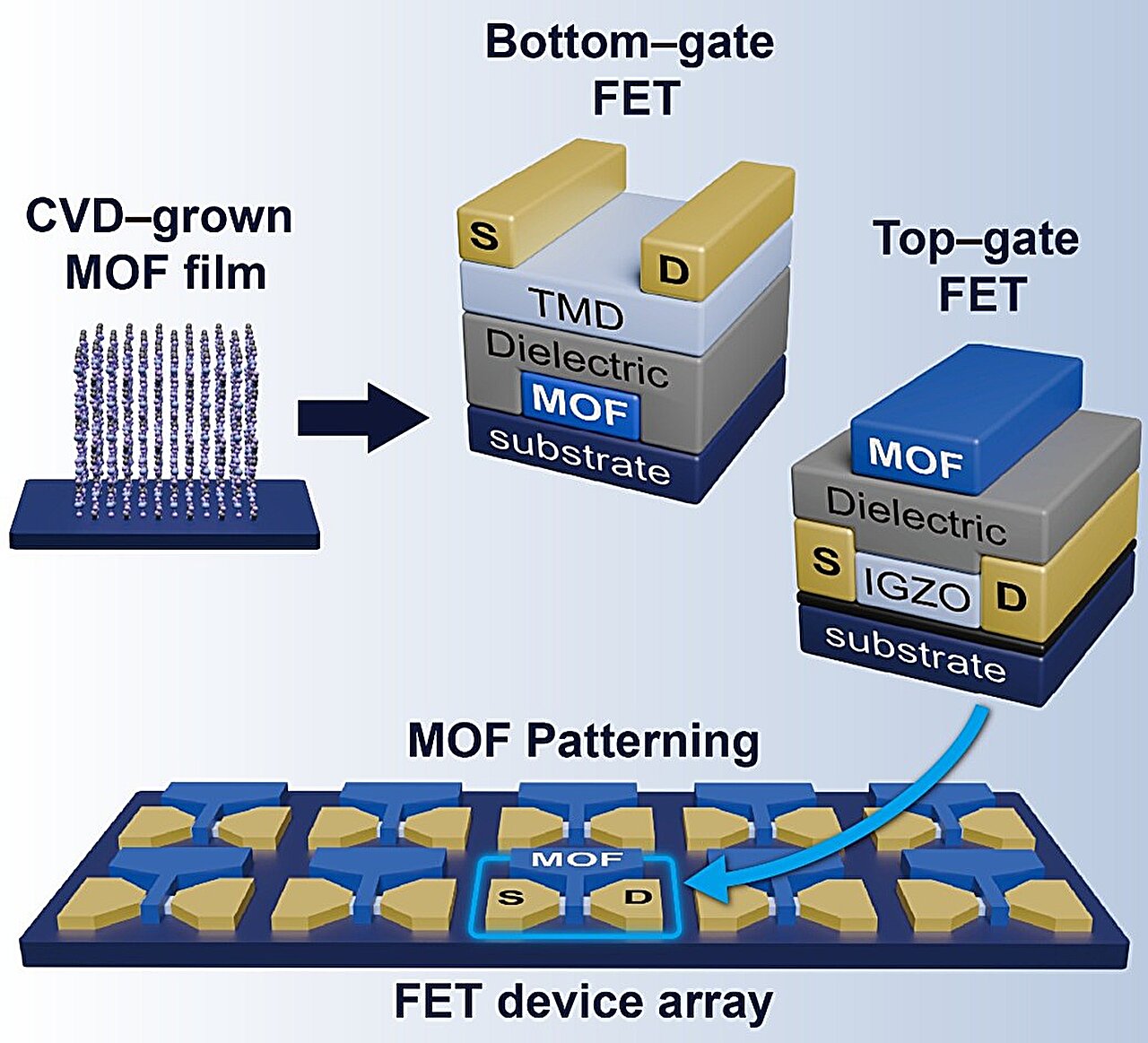
A research team led by professor Sarah S. Park from the Department of Chemistry, in collaboration with researchers from Pukyong National University, POSTECH and Yonsei University, has processed electrically conductive metal–organic frameworks (MOFs) into thin, precisely patterned films and used them as gate electrodes in semiconductor devices.
The team applied the electrodes to field-effect transistors (FETs). A transistor is a basic semiconductor component that switches current on and off or regulates its flow in response to an electrical signal. Applying a voltage to the gate electrode controls the flow of current through the transistor.
Gate electrodes are currently made mainly from metals, which conduct electricity well. However, each metal has fixed electronic properties. This makes it difficult to adapt the electrode to the requirements of a given semiconductor.
Conductive MOFs are materials in which metal ions and organic molecules are linked in a regular structure.
Source link