OpenEnv is a tool for creating an agentic execution environment like terminals, browsers, or anything an agent can interact with. And today, we’re excited to announce that OpenEnv is becoming even more open, to make the future of training agents open source.
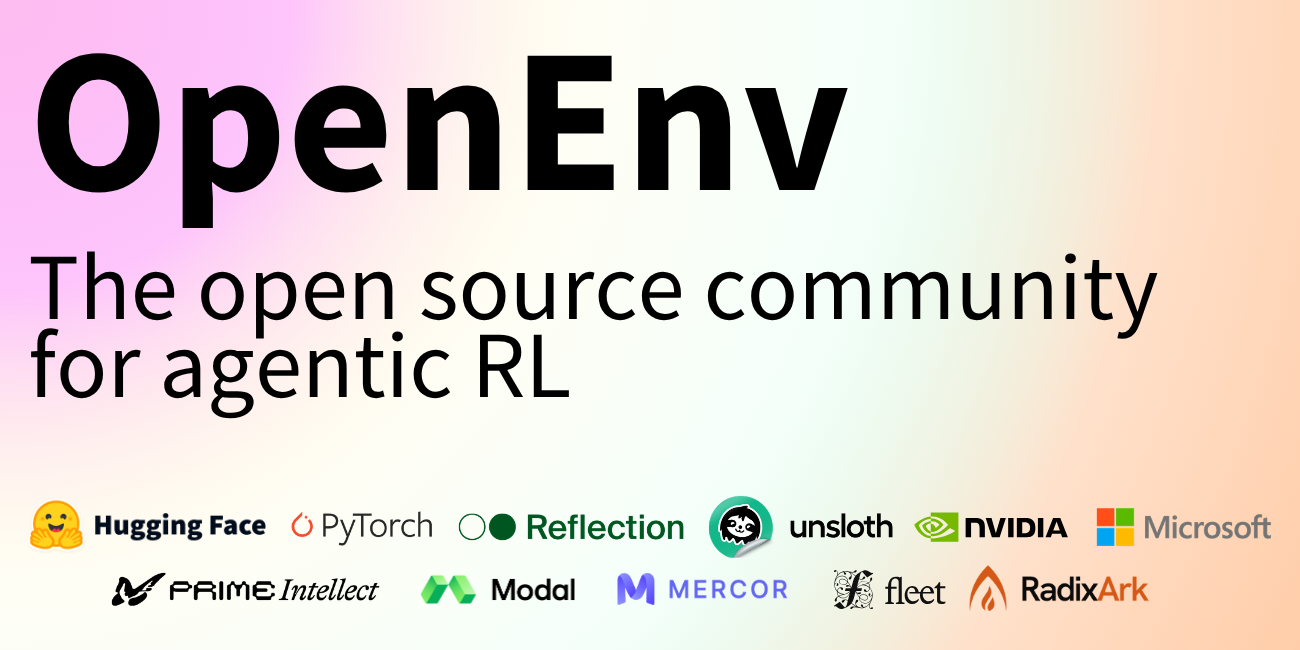
Starting today, OpenEnv will be coordinated by a committee that so far includes Meta-PyTorch, Reflection, Unsloth, Modal, Prime Intellect, Nvidia, Mercor, Fleet AI, Microsoft, Hugging Face, and RadixArk. OpenEnv now lives at huggingface/OpenEnv
OpenEnv project is supported and adopted by some of the leading organizations in the AI ecosystem, including PyTorch Foundation, vLLM, SkyRL (UCB), Lightning AI, Axolotl AI, Stanford Scaling Intelligence Lab, Mithril, OpenMined, Scaler AI Labs, Scale AI, Patronus AI, Surge AI, Halluminate, Turing, Scorecard, Snorkel AI, SGLang, and Miles.
Agent harnesses like Claude Code, Codex, OpenClaw, and Hermes just keep improving. One reason for their improvement is that models like GPT-5.5 and Opus 4.8 are trained to use their respective harnesses.
We want those gains with open source models too: training local models that use harnesses effectively, and saving compute by specializing models for specific tasks.
Frontier labs train models and harnesses that, for the most part, work like hand in glove. The model is trained to use the harness and optimised for its characteristics. Models can generalise beyond these harnesses, to some extent, but nothing beats the efficiency of training.
In the open, this isn’t the case. Developers use any harness, any model, any inference engine, on whatever use case they value. This is fundamental to the community, but it’s also a challenge that requires infrastructure and tooling to tackle.
Source link