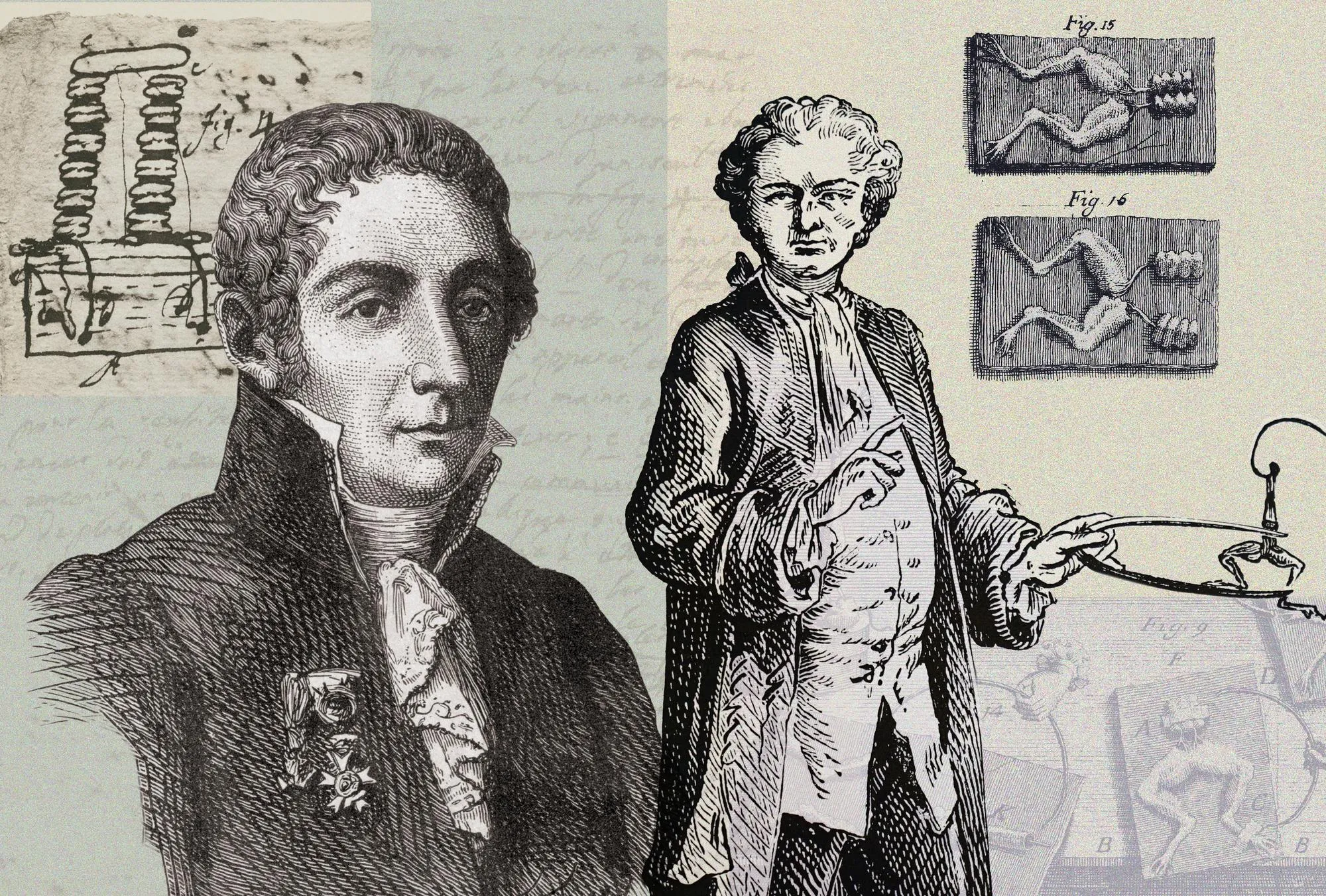
In a display case on the lower level of the Faraday Museum at the Royal Institution in London, there’s an unassuming stack of gray metal discs and blotting paper. It’s not at all obvious that this humble object is the starting point of today’s multibillion-dollar global battery industry. The object’s invention in 1799 grew out of a disagreement that Alessandro Volta—the Italian physicist for whom the unit of measurement for electrical potential is named—had with his friend Luigi Galvani over a dead frog.
Galvani was a well-respected Italian physician. In the 1770s, he began investigating the use of electricity to stimulate the muscles of dissected frogs. Armed with an electrostatic generator and an early type of capacitor called a Leyden jar, he was able to create a charge, store it, and then zap his animal specimens at will. He was intrigued when the frog legs twitched as if they were still alive. He spent the last three decades of the 18th century studying the phenomenon, and in 1791, he published De viribus electricitatis in motu musculari commentarius (Commentary on the Effect of Electricity on Muscular Motion).
 Luigi Galvani spent decades investigating what he believed to be a natural electric force emanating from animals. Universal History Archive/Getty Images
Galvani saw the frog as embodying an “animal electricity,” an innate vital force that activated nerves and muscles, similar to what had been observed in (living) electric eels and torpedo rays. For Galvani, the frog was an electrical machine analogous to a Leyden jar.
Source link