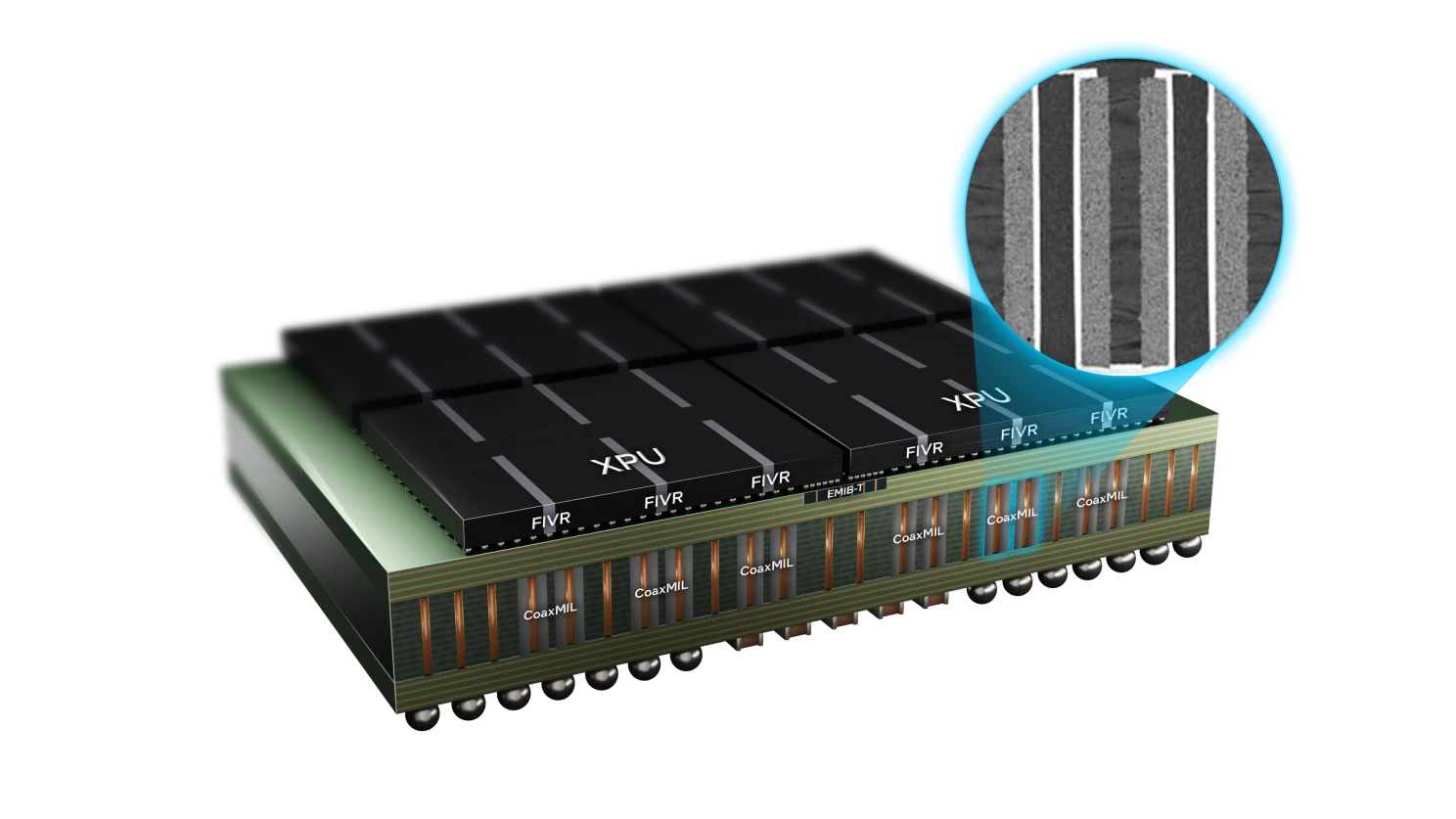
The semiconductor industry has embraced multi-chip and stacked-die architectures as the primary path for continued performance scaling. As monolithic designs become more difficult and costly to advance, chiplets, advanced packaging, and 3D integration enable higher levels of performance, bandwidth, and functional integration for AI and high-performance computing (HPC) systems.
Yet the success of stacked-die, multi-chip architectures has exposed a growing power delivery challenge. As more compute resources are integrated into a package, there is a sharp uptick in current density and the number of independent voltage domains, placing unprecedented demands on shared power delivery resources.
To address these challenges, we discussed in our recent power delivery white paper how Intel Foundry is moving voltage regulation closer to the load. By enabling higher-voltage power distribution, integrated voltage regulators (IVRs) reduce current density in the package, provide higher regulation bandwidth, and reduce reliance on large decoupling capacitor networks. Intel Foundry’s portfolio spans package-integrated magnetic inductors, fully capacitive IVR chiplets, and advanced package integration technologies, providing multiple paths to improve power integrity, efficiency, and scalability.
Advanced packaging delivers significant gains in performance, bandwidth, and integration density. However, consistently distributing power through increasingly complex packaging and interconnect structures introduces new challenges in maintaining power integrity across the package.
One consequence is voltage droop. As AI workloads generate rapid swings in current demand, the power delivery network must respond instantly. When it cannot, voltage can briefly fall below target levels, potentially impacting performance. To maintain reliability, designers often add voltage guard bands and operating margins.
Source link