Graphical User Interface (GUI) automation is one of the most challenging frontiers in computer vision. Developing models that see and interact with user interfaces enables AI agents to navigate mobile, desktop, and web platforms. This will reshape the future of digital interaction.
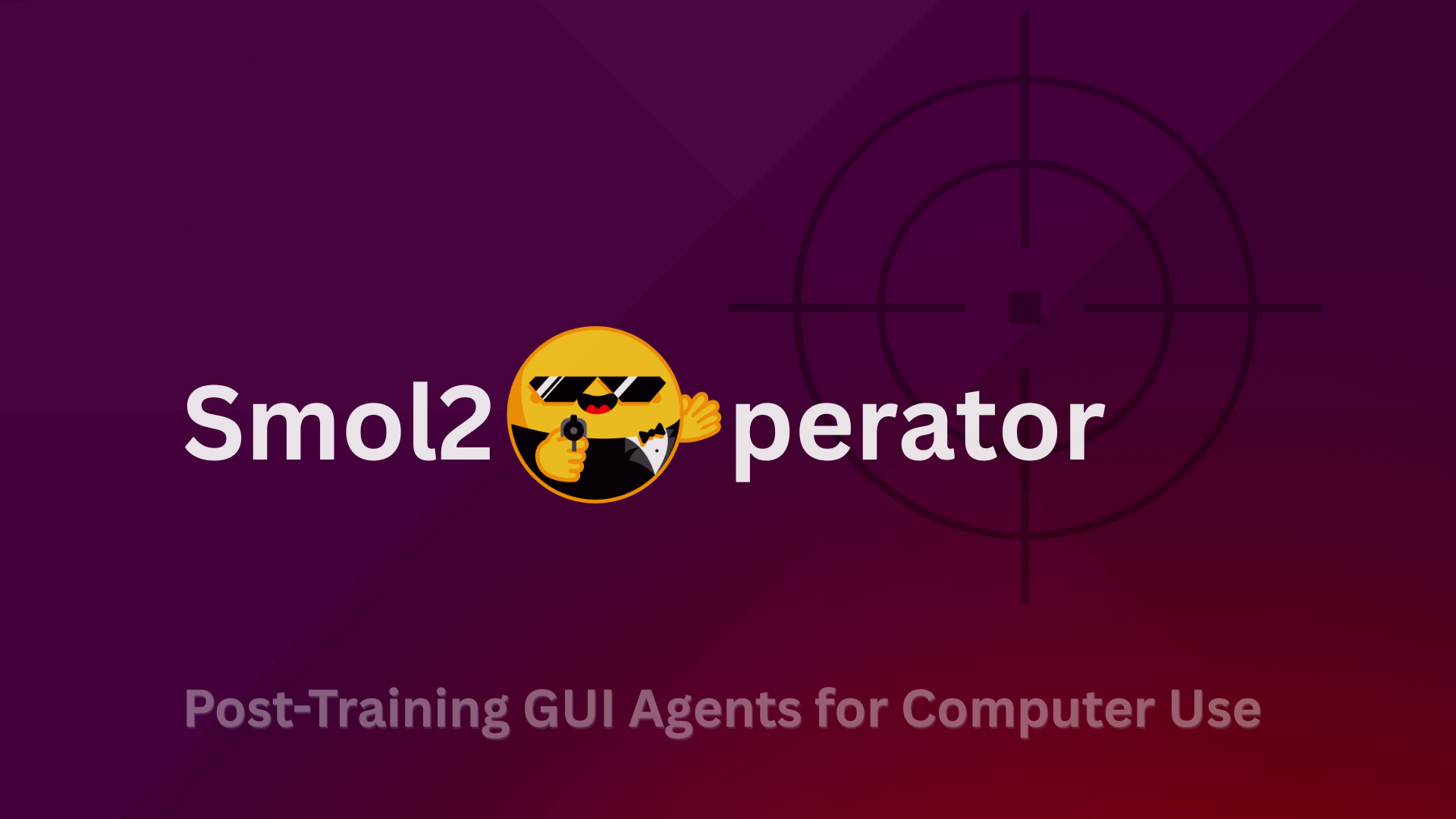
In this blog post, we present a comprehensive approach to training vision-language models for GUI automation through a multi-phase training strategy. We demonstrate how to transform a model with zero grounding capabilities into an agentic coder capable of understanding and interacting with graphical interfaces.
Rather than aiming for a SOTA model, our goal is to demonstrate the entire process, from data processing to model training, and, in doing so, show how to unlock GUI-grounding capabilities in VLMs.
GUI capabilities combine understanding of the interface and precise element localization. These abilities enable the model to translate high-level tasks into low-level GUI actions such as clicking, typing, …
Our approach leverages SmolVLM2-2.2B-Instruct as the baseline model, a small powerful vision-language model that initially has no grounding capabilities for GUI tasks. This makes it an ideal candidate to demonstrate the effectiveness of our training methodology. Through our two-phase training process, we first instill grounding capabilities in the model, then enhance it with agentic reasoning abilities using Supervised Fine-Tuning (SFT).
We evaluate our approach on an established perception benchmark: ScreenSpot-v2 , which tests the model’s ability to understand and locate elements within screenshots. Our process is inspired by the AGUVIS paper, and we leverage their carefully curated datasets to build upon their foundational work.
Source link