
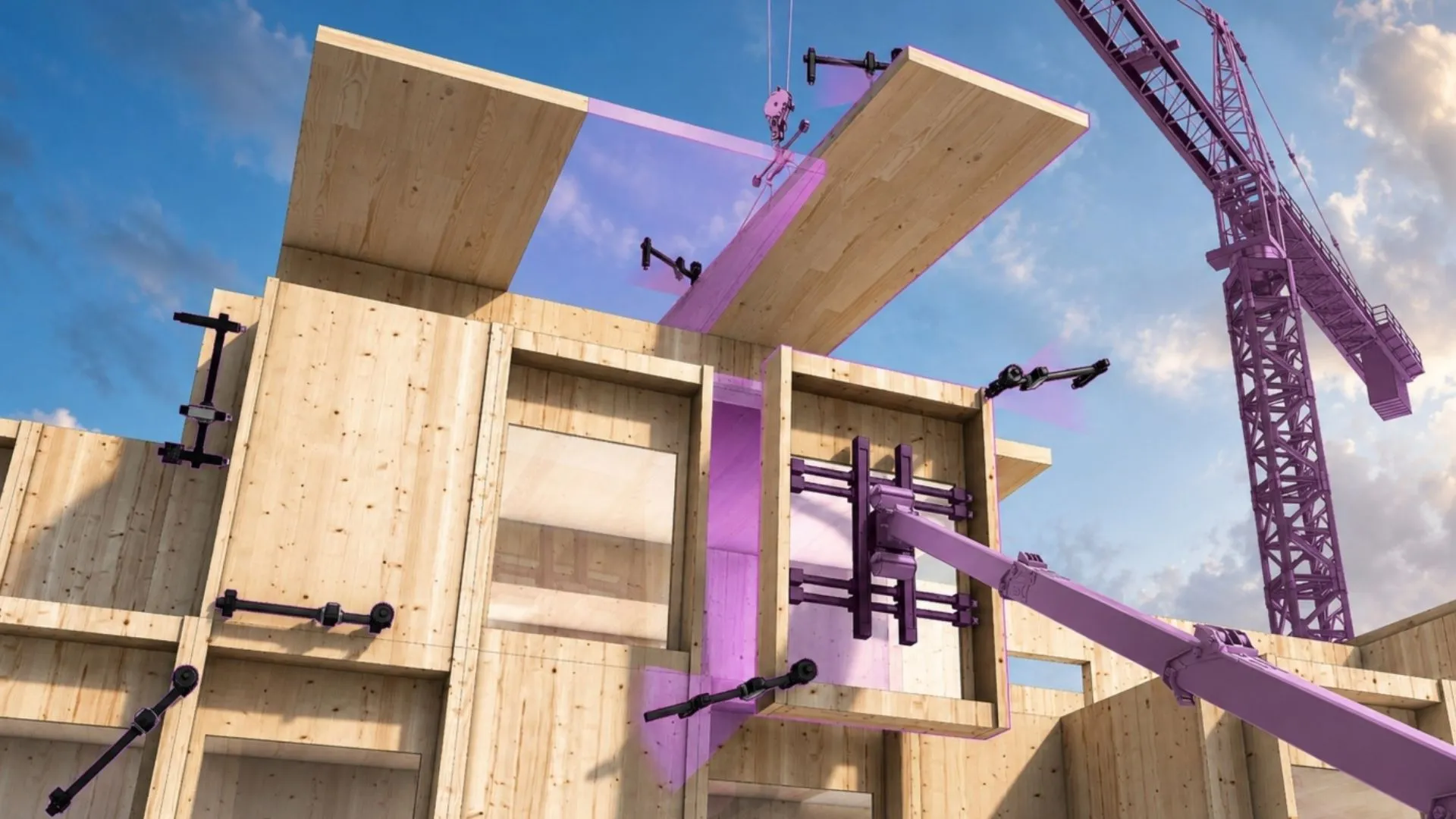
Researchers at the University of Stuttgart in Germany are developing two autonomous robotic systems designed to make construction faster, more productive, and less wasteful. The projects, SCALAR and COBRAS, will explore how teams of robots and construction machines can assemble buildings with less human intervention while supporting more sustainable building methods.
Both projects have secured funding through the European Innovation Council’s EIC Pathfinder Challenge, with each receiving approximately €4 million (approx. $9 million). Coordinated by the university’s Institute for Computational Design and Construction (ICD), the three-year projects are scheduled to begin in November 2026.
The research focuses on two different approaches to robotic construction: autonomous machines assembling prefabricated timber modules and swarms of smaller robots building reusable lightweight structures.
The SCALAR project aims to improve modular timber construction, in which building components are manufactured off-site and assembled at the construction site. The approach can reduce on-site construction time, while timber offers a renewable alternative to some conventional building materials.
According to the University of Stuttgart, SCALAR will develop a timber construction system featuring universal connections and digital design processes, alongside a multi-scale robotics platform capable of assembling timber modules autonomously.
The system will divide construction tasks between different machines. Retrofitted cranes will transport components and position them roughly, while mobile robots handle more precise assembly work. Before construction begins, researchers plan to simulate the assembly process in a virtual environment. A digital control system will then coordinate operations in real time and help maintain safety on-site.
Developing sensors that can operate reliably amid construction-site dust, dirt, and difficult lighting conditions will also be a key part of the project.
Source link





