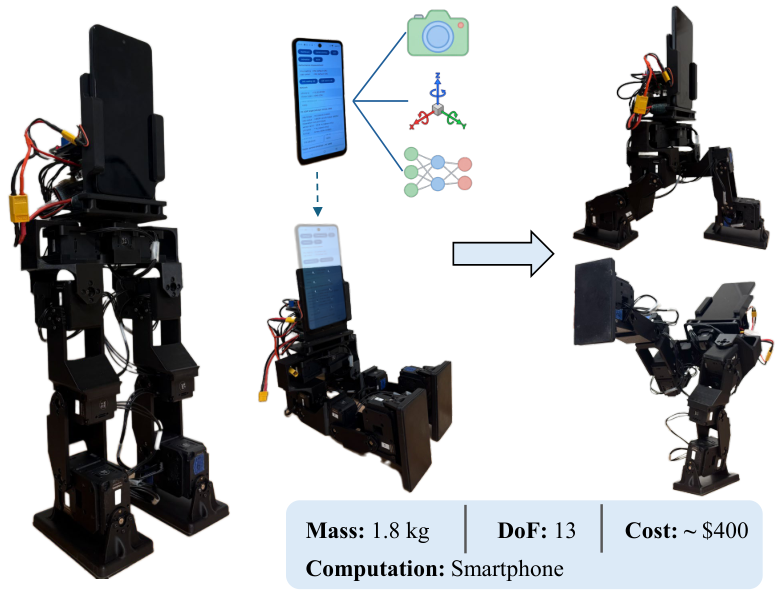
The smartphones lying idle in drawers could serve as brains for the bipedal bot. Researchers at the University of California, Los Angeles, have built a compact walking robot called ‘PhoneBot’ using old, unused Android phones.
Built as an open-source platform, the robot stands tall at about 19 inches (1.5 ft) and weighs under four pounds.
To assist in bipedal movement, the team placed the phone as a torso. Its basic components include a camera, motion sensors, processor, and wireless connection. All these features help the bot to see, maintain balance, and calculate movements, much like the functions performed by the human brain.
The PhoneBot is also equipped with 13 low-cost DYNAMIXEL servo motors, with each leg carrying six of them, maintaining the traditional bipedal leg architecture.
The joints at the hip, knee, and ankle help the robot to walk, turn, and recover as any being with a two-foot locomotory system would. Researchers kept the extra thirteenth joint in the torso to let the upper body spin. These side-to-side movements allow the torso joint the swing the mounted phone camera, helping the bot track a person without moving its feet.
The smartphone sends commands to a Wi-Fi-enabled computer system installed in the lower body of the robot. These wireless information packages are translated into different motor positions. Researchers said the wireless contact between the phone and body was designed to keep the construction and replacement easier.
The design is also kept simple to permit easier phone swapping without the requirement of rewiring, given that smartphones are the only variable factor influencing the costs, researchers added.
Source link