Every result a computer produces comes with an implicit question: did the program run as claimed and produce correct outputs? Today, answering that question often requires a degree of trust alongside verification. We trust the operator, the vendor, the counterparty, or the agent, and we rely on contracts, audits, and logs to establish that trust.
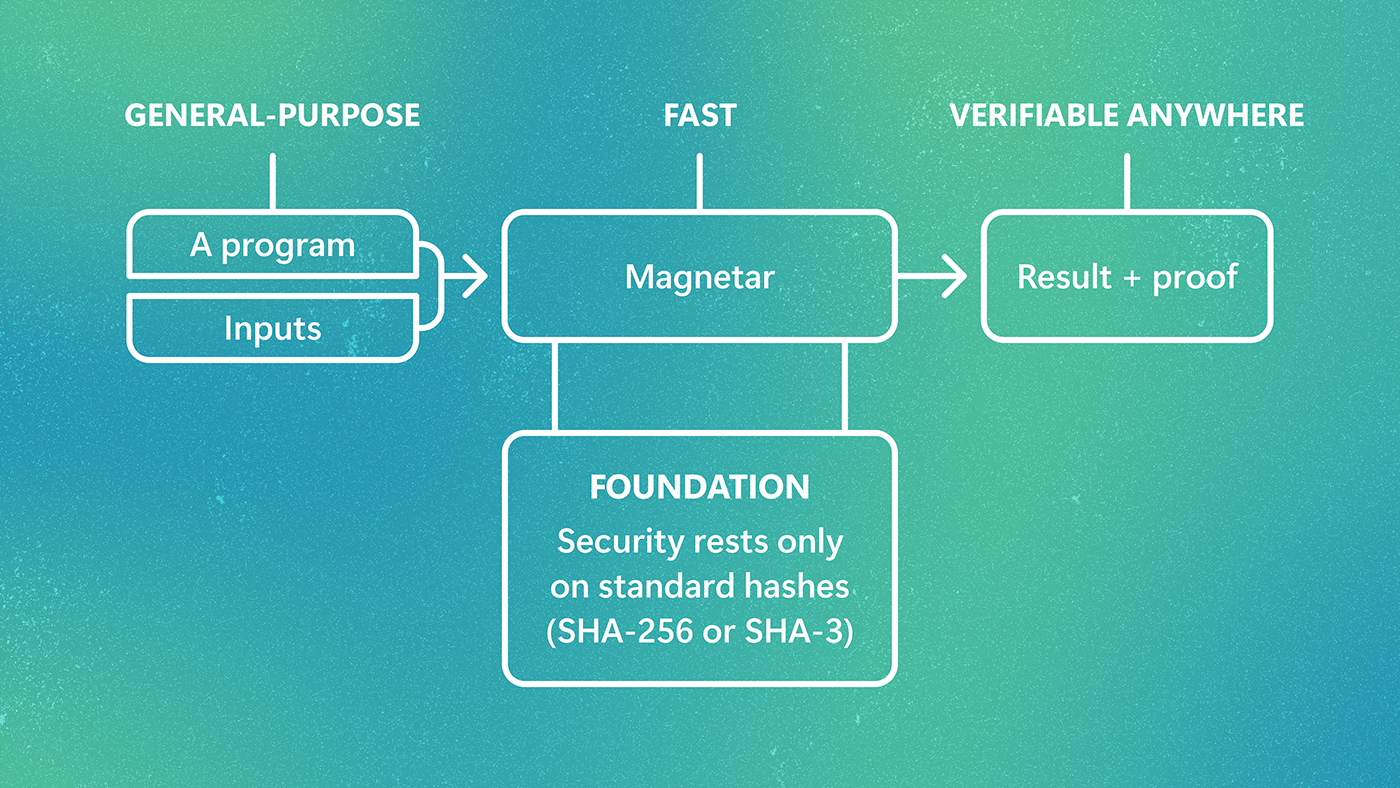
Zero-knowledge proofs offer a fundamentally different approach to establishing trust. A program runs, and along with its output it produces a short proof, a cryptographic certificate that this program, on these inputs, produced this output. The proof is small and fast to check. Whoever receives it can confirm the result in milliseconds without rerunning the program, and can pass the proof on to anyone else who needs the same assurance. With the zero-knowledge property, the proof also reveals nothing about inputs that should stay private.
This changes what correctness means in the real world. A result no longer has to be trusted because of who produced it. It can be checked because of what accompanies it. An AI agent acting on someone’s behalf could attach a proof that each action complied with the policy it was given. Regulated financial institutions could prove that transactions were processed correctly without making their transactions public. These become possible once producing a proof is as routine as running the program.
Zero-knowledge proofs were invented in the 1980s, and the ideas behind proving program execution have been around nearly as long. What has kept them from becoming a general tool is three challenges that have resisted being solved at the same time.
Source link