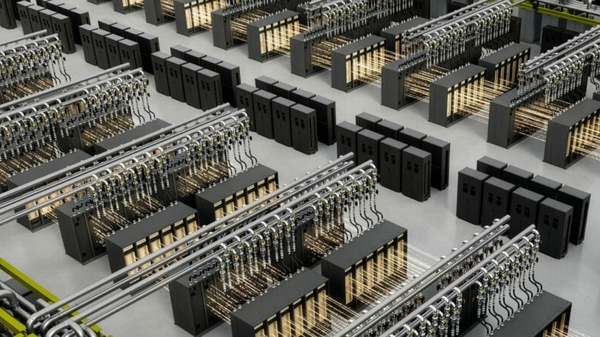
As AI factories grow from megawatts to gigawatts, building them takes more than advanced computing. Open standards are helping the industry scale AI infrastructure faster, more efficiently and more reliably.
At the Open Compute Project (OCP) Global Summit, taking place in the San Jose McEnery Convention Center, NVIDIA announced new partnerships and contributions aimed at creating a common foundation for next-generation AI infrastructure.
NVIDIA contributed key NVIDIA Vera Rubin rack and compute tray designs to OCP through the open NVIDIA MGX architecture, giving system builders a common foundation for developing next-generation AI factory infrastructure.
Together, these efforts span the AI factory itself, the utility grid that powers it and the rack-scale architecture at the heart of modern accelerated computing.
At the OCP event, NVIDIA and partners made a handful of announcements:
Before a packed audience, Ian Buck, vice president of hyperscale and high-performance computing at NVIDIA, discussed how open infrastructure is becoming a critical ingredient for scaling AI factories worldwide.
The news at OCP spotlights how NVIDIA’s extreme codesign combined with open standards is accelerating deployment, improving power efficiency and driving tokens-per-watt performance.
NVIDIA joined industry leaders in contributing to the third-generation MGX AI data center reference design through OCP’s Open DC Initiative.
Combined with open liquid-cooling technologies such as MQD and MQDB, the effort helps turn proven AI factory designs into industry standards that others can adopt, manufacture and scale.
2 specification extends the open architecture for AI factories with rack-scale blind-mate liquid cooling, interoperable rack-scale interconnect infrastructure and a liquid-cooled 5,000A busbar designed for higher-power AI systems.
Source link