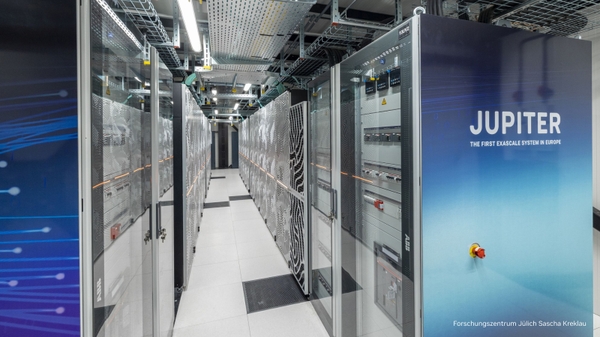
NVIDIA today announced a record-breaking quantum computing simulation on JUPITER, Europe’s first exascale supercomputer, allowing researchers to fully explore and validate magic state cultivation — a leading approach to fault-tolerant quantum computing that requires 90% fewer qubits than previous methods.
Running on a system of NVIDIA GH200 superchips at Jülich Supercomputing Centre, the 104-qubit simulation is the largest comprehensive simulation of a fault-tolerant quantum processor to date, modeling how a realistic quantum processor performs fault-tolerant computation at record scale.
That level of fidelity gives researchers the data and tools needed to predict the performance of future designs before they are built — reducing reliance on hardware trial and error, and accelerating the path to useful quantum applications in fields like drug discovery, financial modeling and materials science.
“Useful quantum computing will require fantastically complex, fault-tolerant systems — and understanding how they behave at scale is essential to building them,” said Jensen Huang, founder and CEO of NVIDIA. “Our results from Jülich show how quantum processors and GPU supercomputers can work together to tackle research that would otherwise be out of reach — accelerating the discovery of transformative quantum applications.”
“Europe’s investment in JUPITER gives researchers the ability to investigate questions that were previously beyond reach,” said Kristel Michielsen, director of the Jülich Supercomputing Centre at the Forschungszentrum Jülich facility. “Working with NVIDIA, we’re bringing that capability to quantum computing — helping scientists make better-informed decisions about the designs most likely to deliver useful applications.”
Reducing the Resources Needed for Useful Quantum Computing Because qubits operate at the limits of physics, the interactions needed to control them introduce unavoidable, error-inducing noise.
Source link