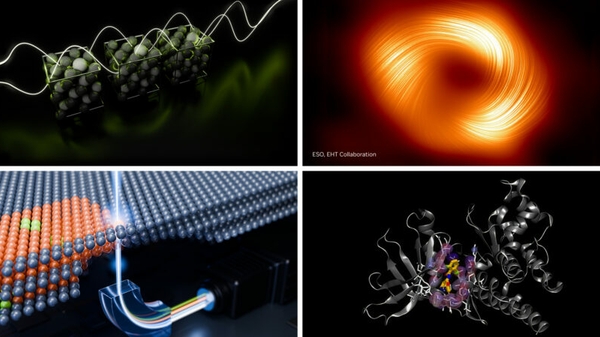
With expanded NVIDIA CUDA-X libraries, including cuPhoton, cuPotential and cuSpa, researchers can sift through vast amounts of data to accelerate research, from astrophysics and materials science to single-cell biology.
The speedups are helping scientists analyze larger datasets and model more complex systems.
The new libraries give AI agents the tools to help researchers make discoveries faster than ever.
Seeing a black hole takes a telescope the size of Earth. The Event Horizon Telescope links radio dishes worldwide, generating petabytes of data that can take months to process.
With NVIDIA cuPhoton.xBeam, a module within the cuPhoton Toolkit, black hole observations from the Event Horizon Telescope can now be correlated orders of magnitude faster than ever. Analysis that once took over a month now takes eight minutes.
By combining global radio dishes into Earth-sized aperture, cuPhoton delivers unprecedented astronomical imaging resolution. cuPhoton successfully correlated observations of powerful black hole jets J1924 and 3C279 in the night sky — making it a reality to reconstruct a Messier 87* black hole galaxy in real time.
The entire pipeline, from data loading and processing to visualization, runs on distributed multi-GPU systems or a compact NVIDIA DGX Spark system, helping scientists study how gas spirals inward under a black hole’s powerful gravitational pull.
Sustaining plasma at millions of degrees is essential to achieving stable, continuous fusion energy. But simulating its behavior is costly: on petascale systems, a single time step can take days, with simulations running for weeks. Experiments also generate data faster than traditional pipelines can process it, often leaving scientists waiting until experiments end to analyze results.
Source link