This article has been reviewed according to Science X's editorial process and policies. Editors have highlighted the following attributes while ensuring the content's credibility:
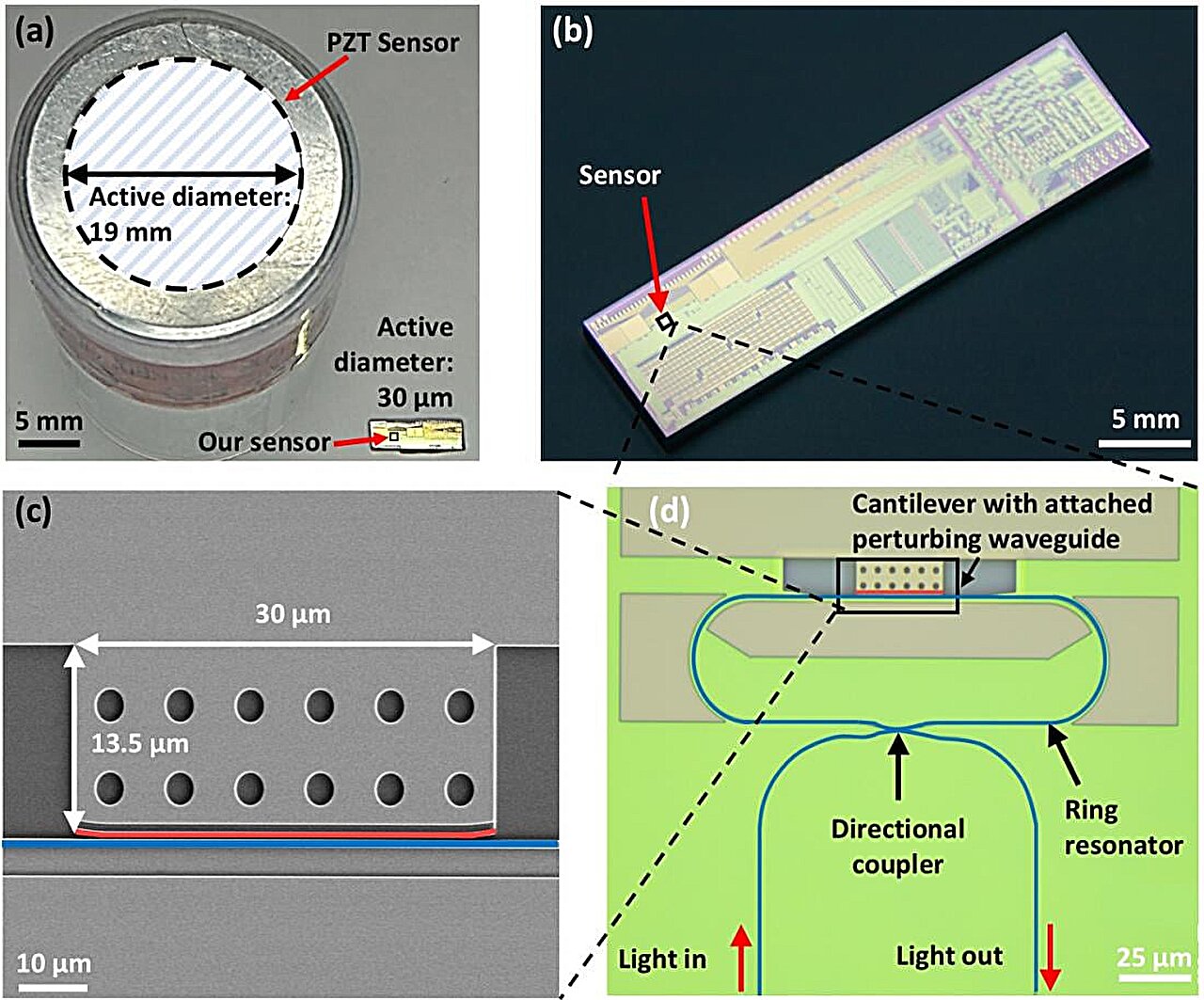
A joint research team led by Professors Sangyoon Han and Jaesok Yu of the Department of Robotics and Mechatronics Engineering at DGIST has developed the world's first miniature optical ultrasonic sensor, thinner than a human hair, using semiconductor fabrication processes. The sensor can precisely detect megahertz (MHz)-range ultrasound transmitted through the air without directly contacting the target object and is expected to revolutionize nondestructive testing technologies for detecting internal defects in semiconductors and secondary batteries.
Ultrasonic nondestructive testing, which detects internal defects without disassembling machinery, generally requires a medium such as gel to be applied to the target object (contact testing) to ensure accurate inspection. However, this method is difficult to apply to advanced components that are sensitive to contamination or damage. The work is published in the journal Photonics Research.
A "non-contact" approach that transmits and receives ultrasound through the air has been considered an alternative, but it has a critical limitation: Ultrasonic signals weaken rapidly in air. In particular, detecting microscopic defects requires high frequencies (in the MHz range), but signal attenuation becomes more severe as the frequency increases. As a result, developing a sensor that combines "high-frequency operation, high sensitivity, and miniaturization" has long been a major challenge.
The research team achieved a breakthrough in addressing this problem by using an optical approach that detects minute vibrations caused by sound (ultrasound) using light.
Source link