If you'd rather skip straight to the good part, here's the full comparison table (no reading required, we won't judge).
But seriously, if you stick around, you might learn a thing or two about why your GPUs are idle 60% of the time.
Async RL training has emerged as the dominant paradigm for post-training at scale. Several trends in modern post-training have made synchronous training loops nearly impossible to scale:
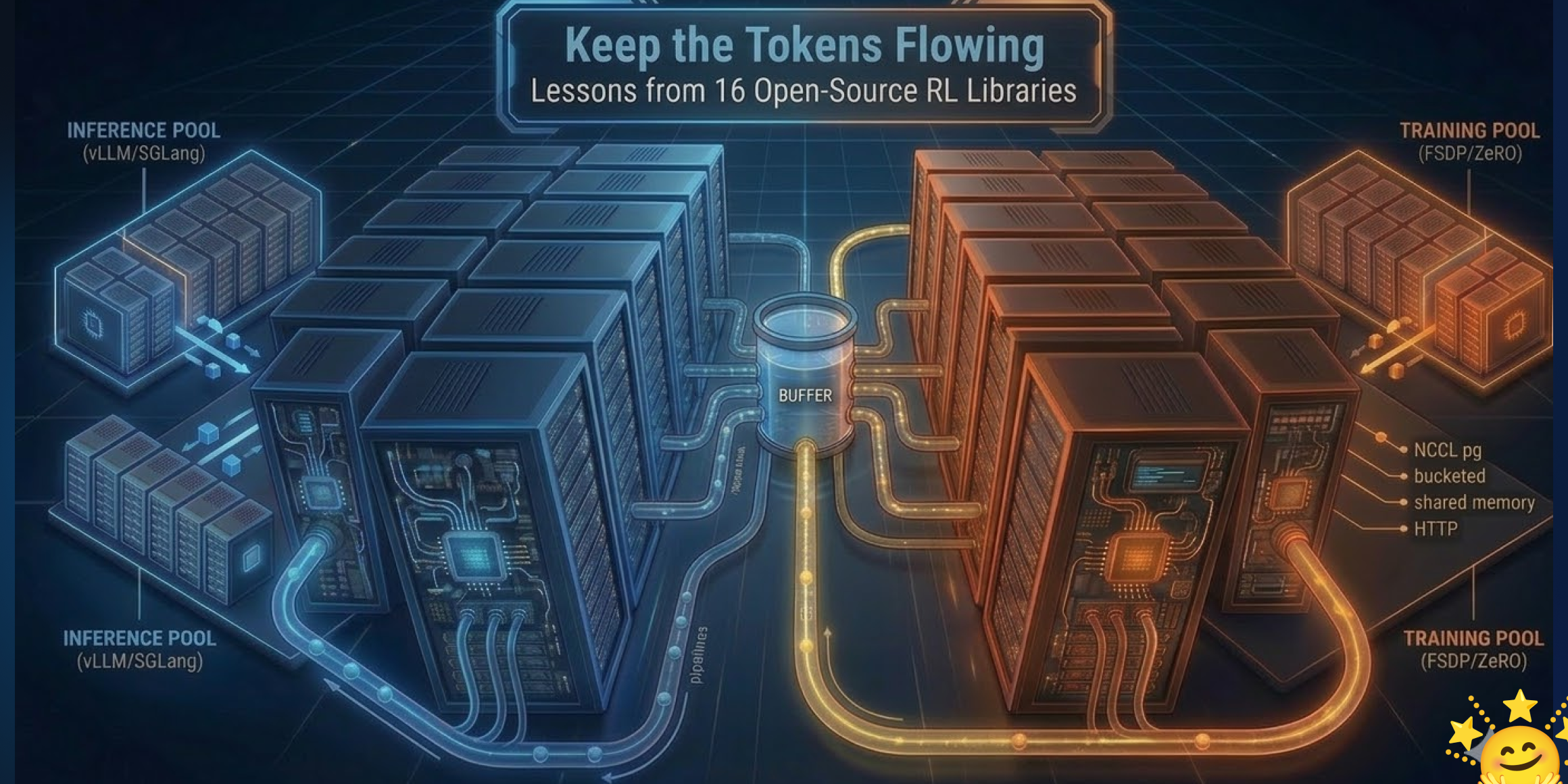
The open-source ecosystem has converged on a common architectural response: disaggregate inference from training onto separate GPU pools, connect them with a rollout buffer, and let both sides run concurrently.
We are developing a new async trainer for TRL, one of the most widely used libraries for model post-training. To guide our design, we surveyed sixteen open-source libraries that were built from the ground up around asynchronous training and compared them across seven axes: orchestration primitives, buffer design, weight sync protocols, staleness management, partial rollout handling, LoRA support, and distributed training backends. This article distills the design principles we extracted from that survey.
Beyond RL, the need for async infrastructure is increasingly evident. For example, on-policy distillation, where a student generates sequences and a teacher scores them, mirrors GRPO but swaps the reward function for a teacher forward pass. Recognizing this structural similarity, everything in this survey applies equally to async distillation. We'll return to this broader point in Section 5.
TRL's current GRPOTrainer implements the full GRPO loop (prompt sampling, generation, reward scoring, advantage computation, gradient update, and weight sync) in a single synchronous training_step() call.
Source link