Language models can do a lot. They write, summarize, translate, and call tools. But they're only a small part of what machine learning can do.
Say a customer calls your support line. First, you want to know what they said (speech recognition). Then, you want to decide where to send them (decision). You could hand both to a language model, but there are models built for each that are better, faster, and less expensive.
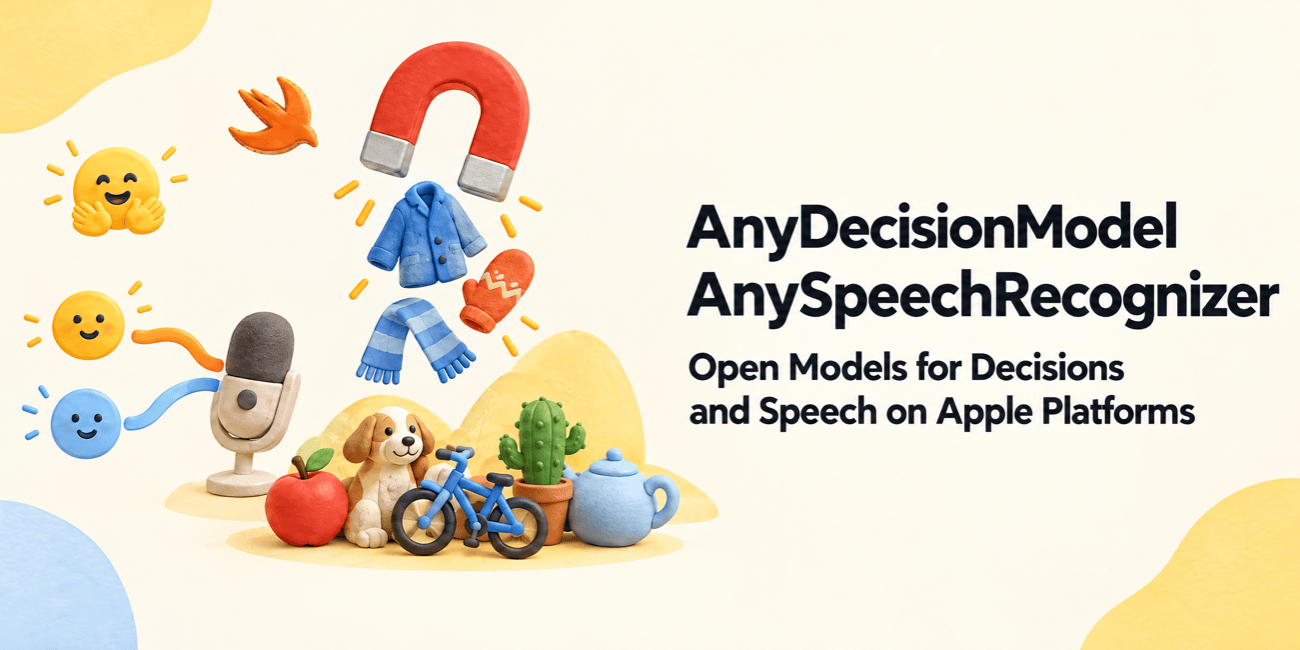
In our AnyLanguageModel 1.0 recap, we looked at a year of local and hosted models in Swift. With AnyLanguageModel and swift-huggingface now on their 1.x releases, we're extending the same approach to speech and decisions: familiar Swift APIs with a choice of model.
Both packages can download open models from the Hugging Face Hub and run them on device.
Computers have been transcribing speech for decades, and in the past few years, they've gotten very good at it. Apple platforms already have an API for it. macOS 26 and iOS 26 introduced SpeechAnalyzer, Apple's new speech-to-text API. You add modules such as SpeechTranscriber and SpeechDetector to an analyzer, give it a file or a stream of audio buffers, and read results from async sequences as they arrive. AssetInventory installs the models, so your app decides when downloads happen.
It's a well-designed API, but the only engine behind it is Apple's. AnySpeechRecognizer keeps the API and lets you choose the engine:
The package mirrors SpeechAnalyzer , SpeechTranscriber , DictationTranscriber , SpeechDetector , and AssetInventory , with Apple's Speech framework as the default engine.
Source link