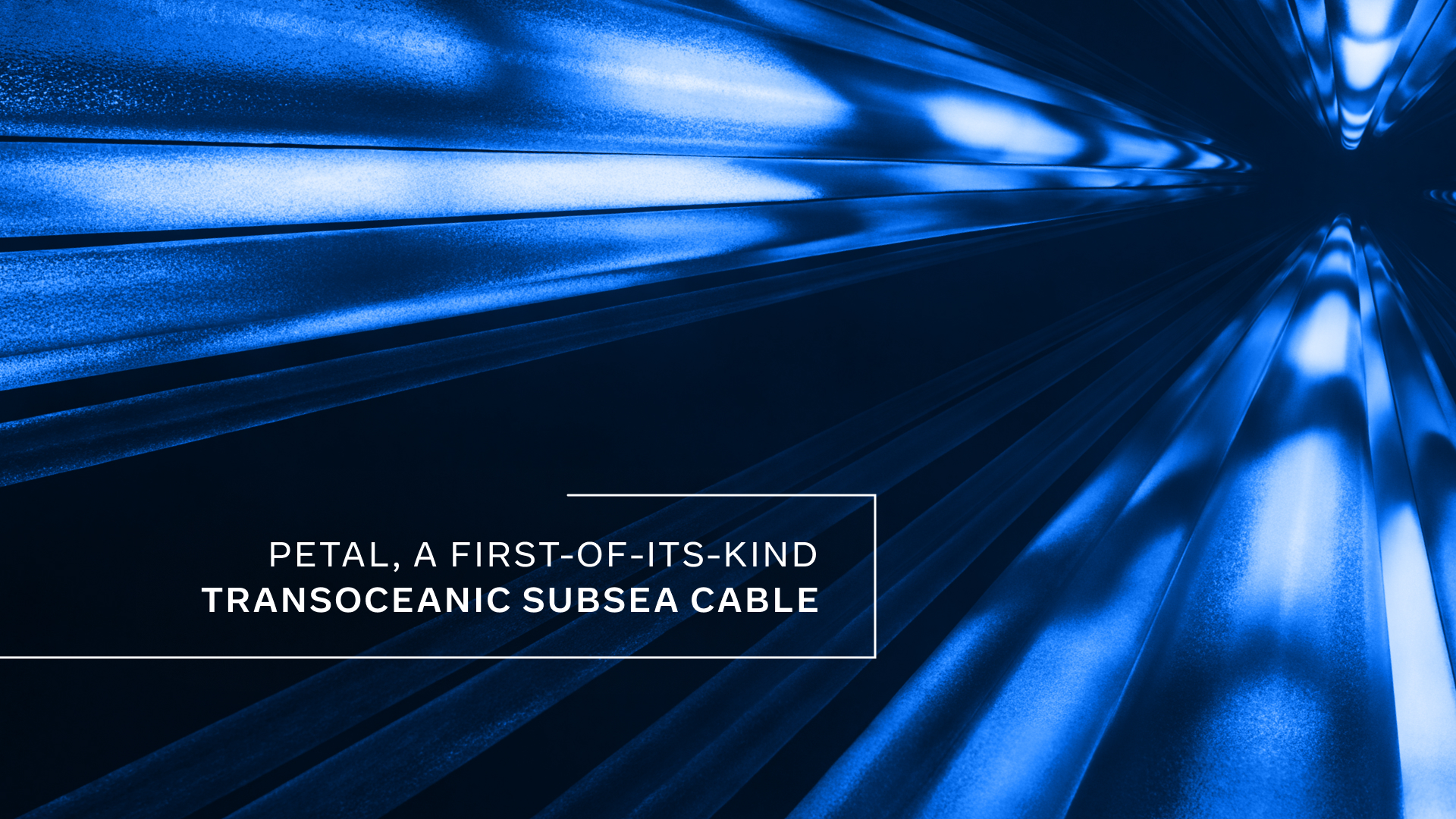
Today, we’re announcing Petal, the first transoceanic subsea cable at petabit capacity, and the first to deploy multi-core fiber at scale. Spanning 7,000 km between France and the United States, Petal will deliver 1 Pbps (1 petabit per second or 1,000 terabits per second), doubling what today’s most advanced subsea cables carry at this distance.
That’s roughly the network capacity required for 75% of the world’s population to stream music at the same time.*
Petal is a key piece of Meta’s subsea cable investments bringing greater capacity, stronger resiliency, and future-proof infrastructure to Europe as demand for communications and reliable connectivity continues to increase.
The road to this point has taken years of collaborative engineering with our partners and a complete rethinking of the subsea industry’s approach to cable design.
A subsea cable is the least visible, yet one of the most critical layers of the internet. Approximately 99% of intercontinental data traffic – nearly every message, phone, or video call between continents – travels through glass strands on the ocean floor.
Since the introduction of the erbium-doped fiber amplifier (EDFA) in the 1980s, there have been several transformational shifts in subsea cable capacity. In the 2010s, coherent optical transmission technology and dispersion-uncompensated cable designs launched the industry into a decade of dramatic fiber capacity increases of 10x and more until the ever-looming Shannon Limit finally pushed back.
To overcome this, the industry pivoted to spatial division multiplexing (SDM) to increase the number of fibers within a subsea cable. 5 Pbps transatlantic cable system.
Source link