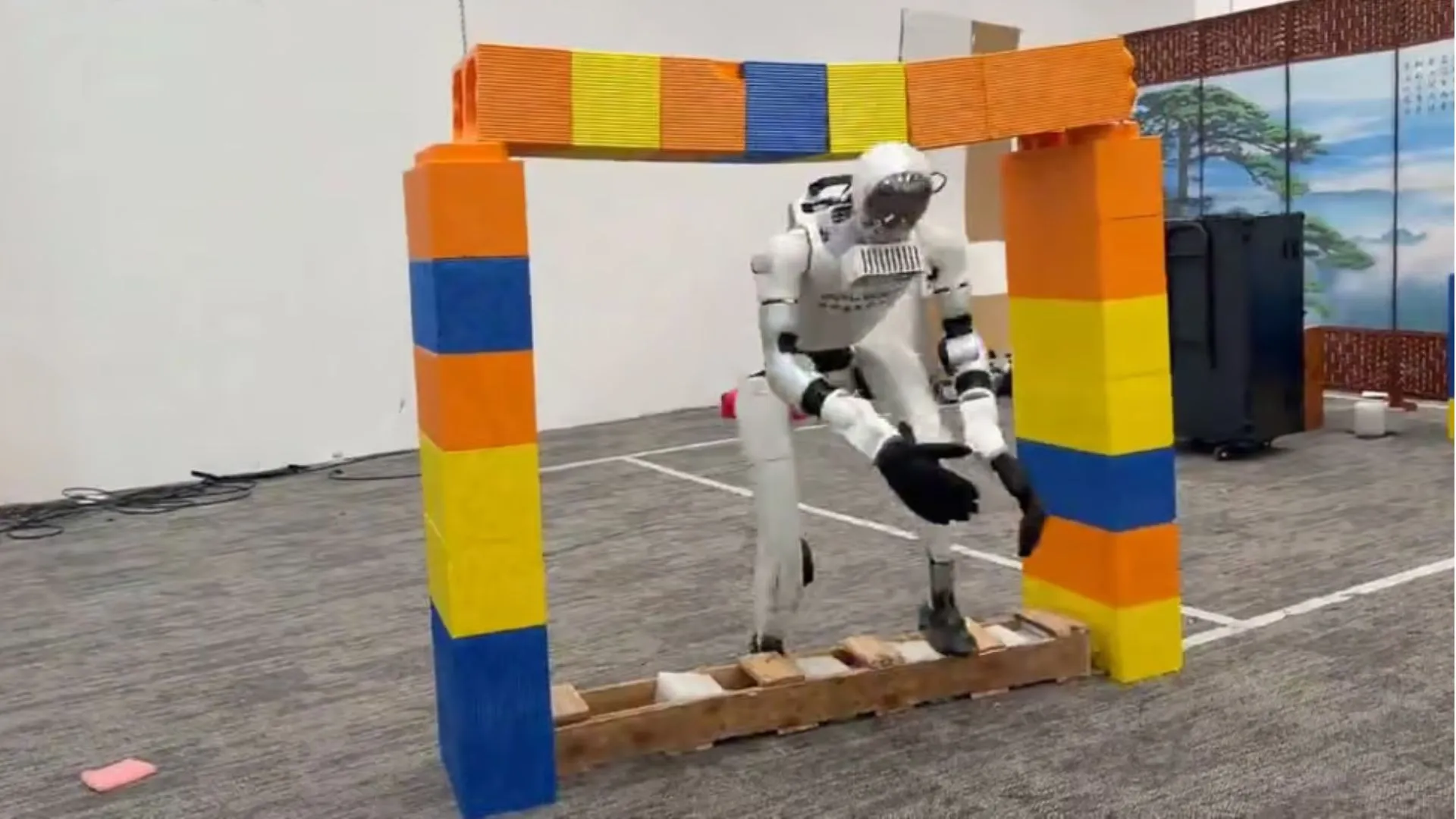
Galbot introduced PASSAGE, a research framework that helps humanoid robots navigate cluttered environments by adapting their movements to obstacles.
The system enables robots to choose different ways of passing through tight spaces, including stepping over objects, ducking under barriers, and turning sideways to fit through narrow gaps.
The framework combines environmental perception, motion planning, and whole-body control to help humanoid robots navigate complex surroundings while maintaining balance and reaching their destinations.
Recently, Galbot’s humanoid robot completed over 100 rallies in a live autonomous tennis match, tracking balls, adjusting positions, and returning varied shots.
The new research framework lets humanoid robots navigate cluttered environments by adapting their whole-body movements to obstacles. The system lets robots choose suitable movements, such as stepping over objects, ducking under overhead barriers, or turning sideways to pass through narrow gaps.
The framework addresses a key challenge in robotics: coordinating a robot’s movements with its understanding of the space around it. Humanoid robots must account for more than whether their feet can pass through an opening. Their heads, shoulders, arms, and torsos must also clear surrounding objects. A robot may have an unobstructed path for its legs but still collide with a low ceiling or a narrow doorway.
Perceiving the environment, understanding spatial constraints, and coordinating whole-body motion are essential for humanoid robots to integrate into human society—and remain major challenges in robotics.
To address this, the Galbot team introduces PASSAGE, a framework that… pic.twitter.com/oYXC7GLvgo
PASSAGE combines environmental perception, motion planning, and whole-body control to address this problem.
Source link