This article has been reviewed according to Science X's editorial process and policies. Editors have highlighted the following attributes while ensuring the content's credibility:
Solid-oxide fuel cells (SOFCs), which convert chemical energy directly into electrical power, are promising energy-conversion technologies because they can operate on various fuels, including hydrogen, natural gas and biogas.
When hydrogen is used as the fuel, water is the main product of the electrochemical reaction. However, conventional SOFCs generally operate at high temperatures, creating challenges related to material degradation, manufacturing costs and compatibility between cell components.
Commercially available SOFC electrolytes, such as yttria-stabilized zirconia (YSZ), typically require high operating temperatures of around 700°C–1,000 °C to maintain high ionic conductivity.
However, such high temperatures can accelerate material degradation and increase costs. Considerable efforts have therefore been devoted to developing electrolyte materials that can operate at lower temperatures of 200 °C–500 °C. Yet, materials that simultaneously combine sufficient oxide-ion conductivity, chemical stability and negligible chemical expansion are very rare in this temperature range.
This gap between 200 and 500 °C, called the "Norby gap," represents an important challenge not only for SOFCs but also for various chemical and energy-conversion processes.
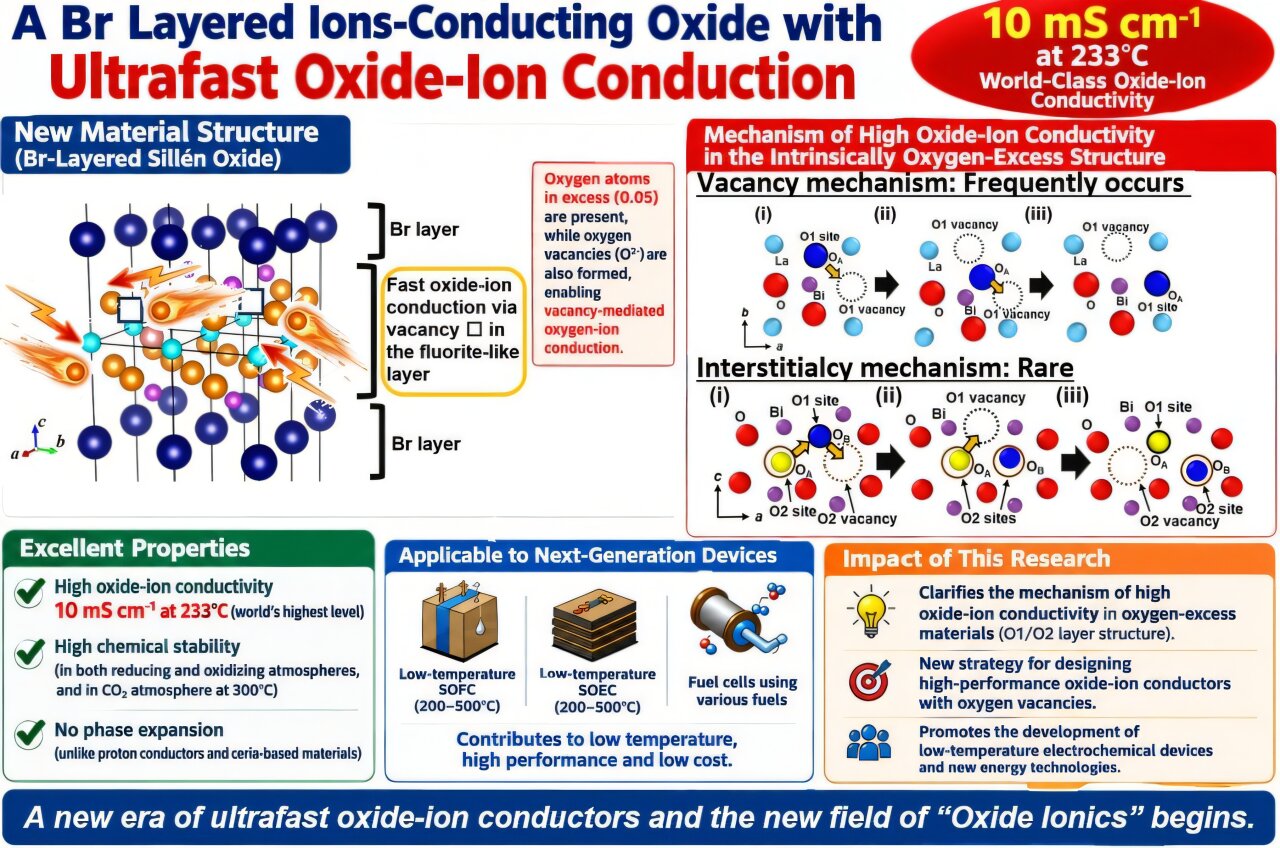
A research team led by Professor Masatomo Yashima of the Department of Chemistry, School of Science at Institute of Science Tokyo (Science Tokyo) in Japan, has discovered a novel Sillén oxybromide, Bi₁.₉Te₀.₁LaO₄.₀₅Br, that exhibits high bulk oxide-ion conductivity within the Norby gap.
"This oxide-ion conductor not only demonstrates significantly higher ion conductivity than leading proton conductors but also exhibits negligible chemical expansion and high chemical stability.
Source link