Voice AI only feels natural if conversation moves at the speed of speech. When the network gets in the way, people hear it immediately as awkward pauses, clipped interruptions, or delayed barge-in. That matters for ChatGPT voice, for developers building with the Realtime API, for agents working in interactive workflows, and for models that need to process audio while a user is still talking.
Fast connection setup so a user can start speaking as soon as a session begins
Low and stable media round-trip time, with low jitter and packet loss, so turn-taking feels crisp
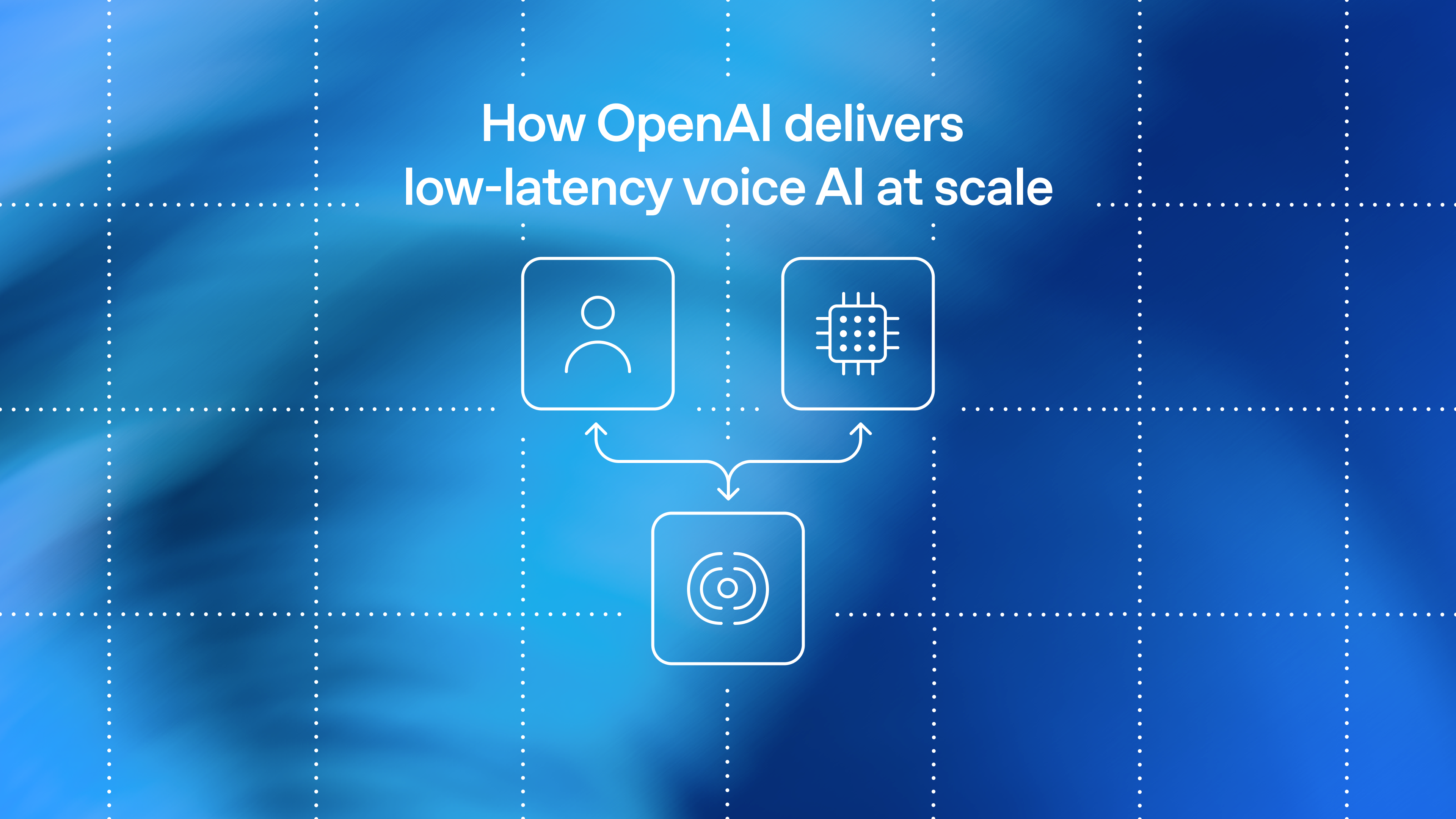
The team at OpenAI responsible for real-time AI interactions recently rearchitected our WebRTC stack to address three constraints that started to collide at scale: one-port-per-session media termination does not fit OpenAI infrastructure well, stateful ICE (Interactive Connectivity Establishment) and DTLS (Datagram Transport Layer Security) sessions need stable ownership, and global routing has to keep first-hop latency low. In this post, we walk through the split relay plus transceiver architecture we built to preserve standard WebRTC behavior for clients while changing how packets are routed inside OpenAI’s infrastructure.
WebRTC is an open standard for sending low-latency audio, video, and data between browsers, mobile apps, and servers. It’s often associated with peer-to-peer calling, but it’s also a practical foundation for client-to-server real-time systems because it standardizes the hard parts of interactive media: ICE for connectivity establishment and NAT (Network Address Translation) traversal, DTLS and SRTP (Secure Real-time Transport Protocol) for encrypted transport, codec negotiation for compressing and decoding audio, RTCP (Real-time Transport Control Protocol) for quality control, and client-side features such as echo cancellation and jitter buffering.
Source link