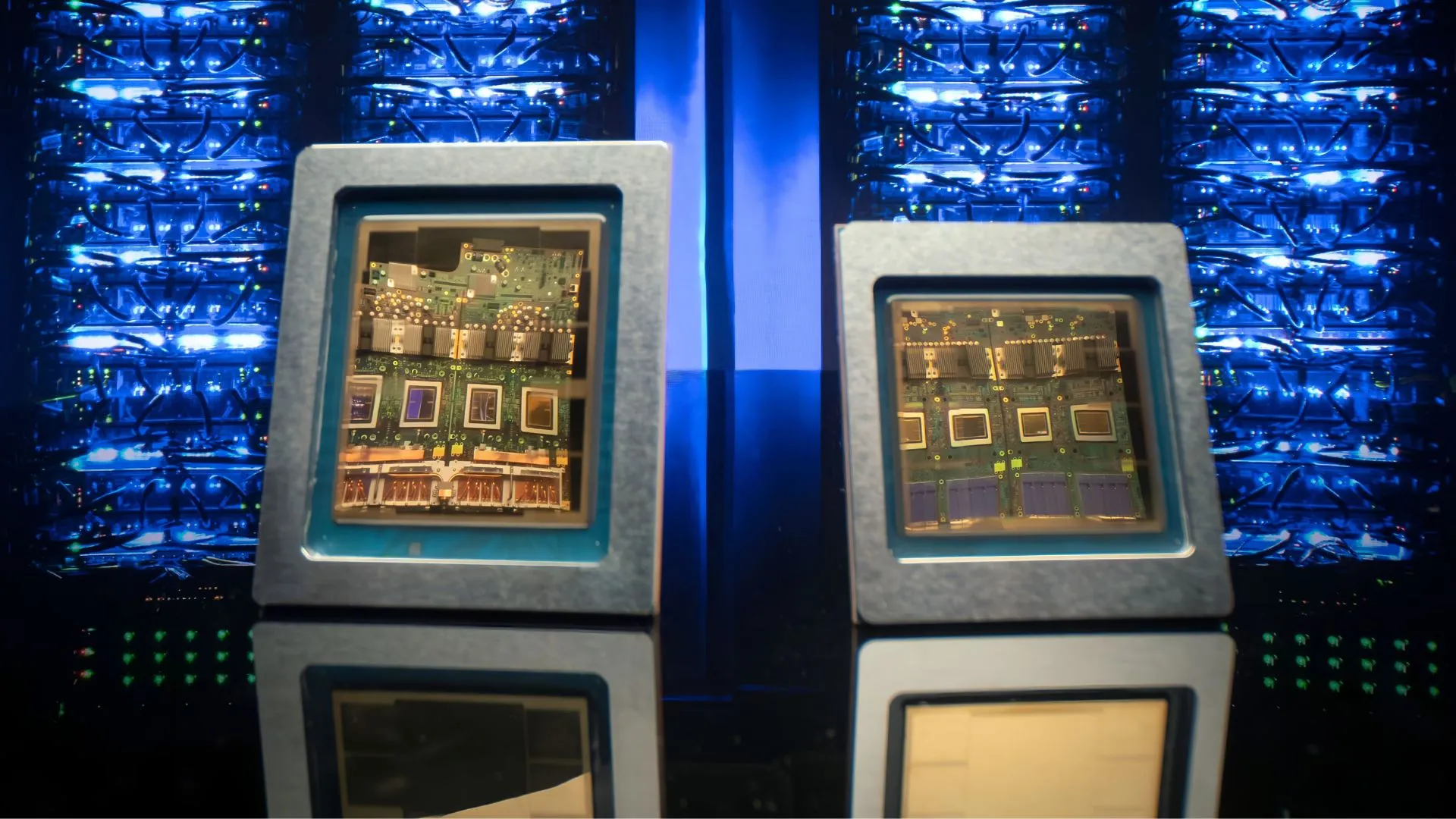
Google has added two specialized systems to its eighth-generation Tensor Processing Unit (TPU) lineup, targeting secure AI computing and workloads requiring massive memory capacity. The expansion gives Google four distinct TPU configurations in one generation, reflecting the growing demands of enterprise AI infrastructure.
The new systems, TPU 8tx and TPU 8i Max, address challenges emerging as businesses deploy autonomous AI agents. One prioritizes confidential computing for sensitive workloads, while the other targets models handling enormous amounts of contextual information.
Google says its TPU business now serves nearly 100 customers. These include AI research labs, financial trading firms, retailers and universities. Customers can also deploy TPUs directly inside their own data centers.
TPU 8tx targets organizations that process sensitive information or operate under strict regulatory requirements. Google has integrated hardware-level confidential computing into the system, protecting data and model weights during active processing.
Typically, processors must decrypt information before working with it. That creates potential exposure even when storage systems and network connections use encryption.
Today, we're expanding our eighth-generation TPU portfolio with two new systems built specifically for the agentic era — bringing our total to four distinct eighth-generation TPU systems launched in a single year.
TPU 8i Max was built for massive context windows and the highest… pic.twitter.com/Ljj622Z5zL
Google addresses this vulnerability through hardware-based isolation. TPU 8tx uses the same silicon as TPU 8t, paired with fifth-generation AMD EPYC CPU hosts. It also incorporates Google’s low-latency Boardfly networking technology.
The configuration delivers up to twice the latency reduction compared with TPU 8t, according to Google.
Source link