Researchers used GPT‑5.2 Pro to help find a new mathematical result describing how particles can interact in quantum gravity.
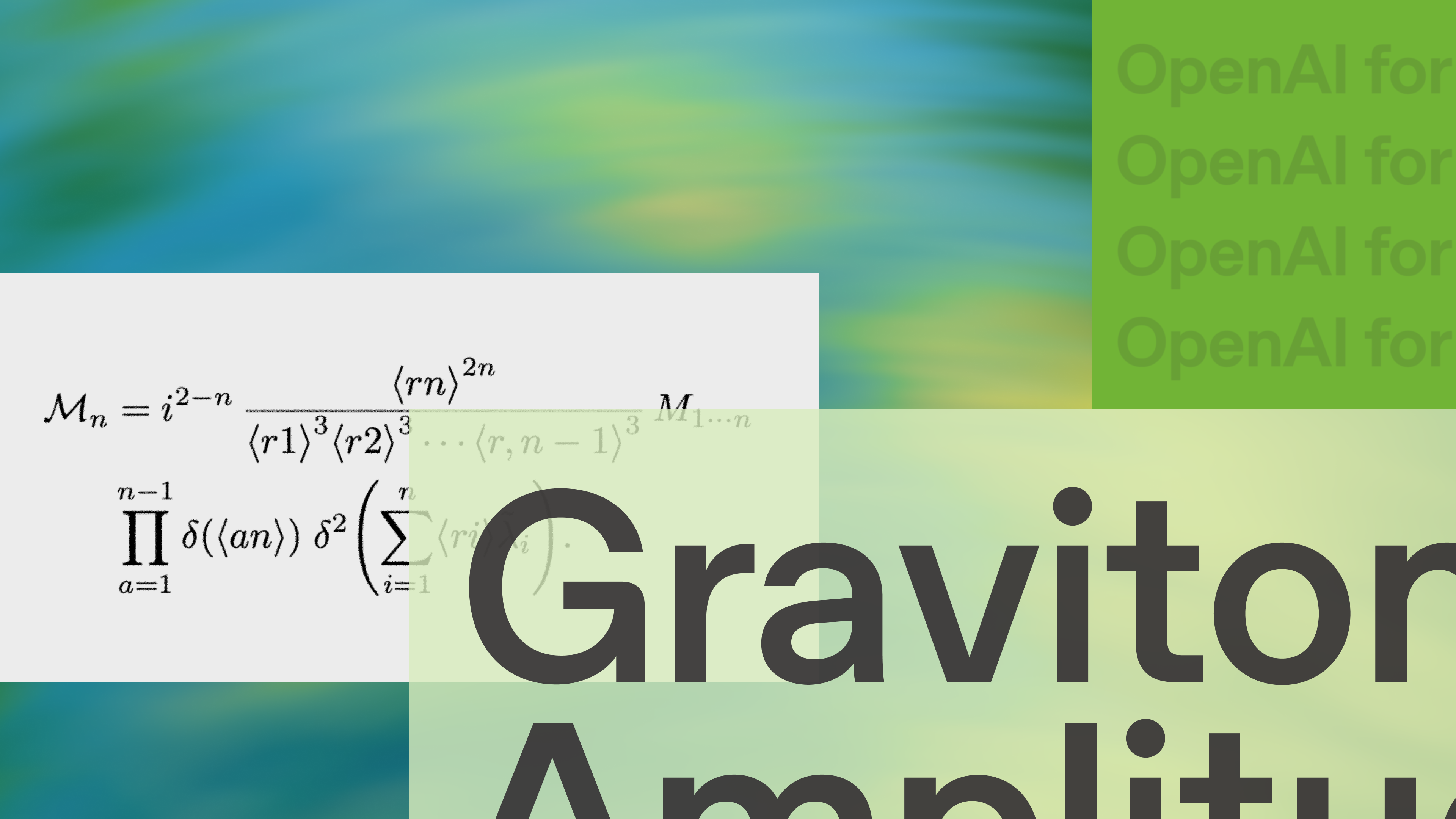
We’ve published a new preprint studying scattering amplitudes in quantum gravity, extending recent results obtained for gluons to the gravitational setting. The work shows that a class of graviton interactions long assumed to vanish can in fact arise under well-defined kinematic conditions. The preprint is available here(opens in a new window). We welcome feedback from the community.
The paper, “Single-minus graviton tree amplitudes are nonzero,” is authored by Alfredo Guevara (Institute for Advanced Study), Alexandru Lupsasca (Vanderbilt University and OpenAI), David Skinner (University of Cambridge), Andrew Strominger (Harvard University), and Kevin Weil (OpenAI) on behalf of OpenAI.
Scattering amplitudes are mathematical quantities physicists use to calculate the probability that particles interact in particular ways. Rather than tracking every intermediate step of a collision through many diagrams, amplitudes encode the final observable outcomes in a compact form. Over the past several decades, researchers have found that amplitudes often display unexpected simplicity, revealing hidden mathematical structure not obvious from traditional calculations.
The new preprint studies gravitons, quantum particles associated with gravity in quantum field theory. In particular, the authors analyze a configuration known as a single-minus amplitude, meaning that one particle has negative helicity while the remaining particles have positive helicity. Helicity describes the orientation of a particle’s spin relative to its direction of motion and plays an important role in determining how interactions occur. Standard textbook arguments suggest that these amplitudes should vanish at the simplest level of approximation, called tree level, where only the most direct interaction diagrams are considered and quantum loop effects are ignored.
Source link