Memory has become an important AI agent capability: the ability to store and retrieve past experiences. But memory alone is not learning. A collection of past conversations, reasoning traces, or action histories can quickly grow into a vast archive of experiences, making it difficult to identify the most relevant knowledge for a new task—let alone refine and evolve this knowledge to improve performance over time.
Humans learn differently. We do not remember every detail of our past experiences. Instead, we remember what matters: strategies that work, mistakes to avoid, and skills that transfer across situations. Over time, these lessons are refined into increasingly general and reusable knowledge. This ability to transform experience into transferable, evolving knowledge is one of the foundations of human learning.
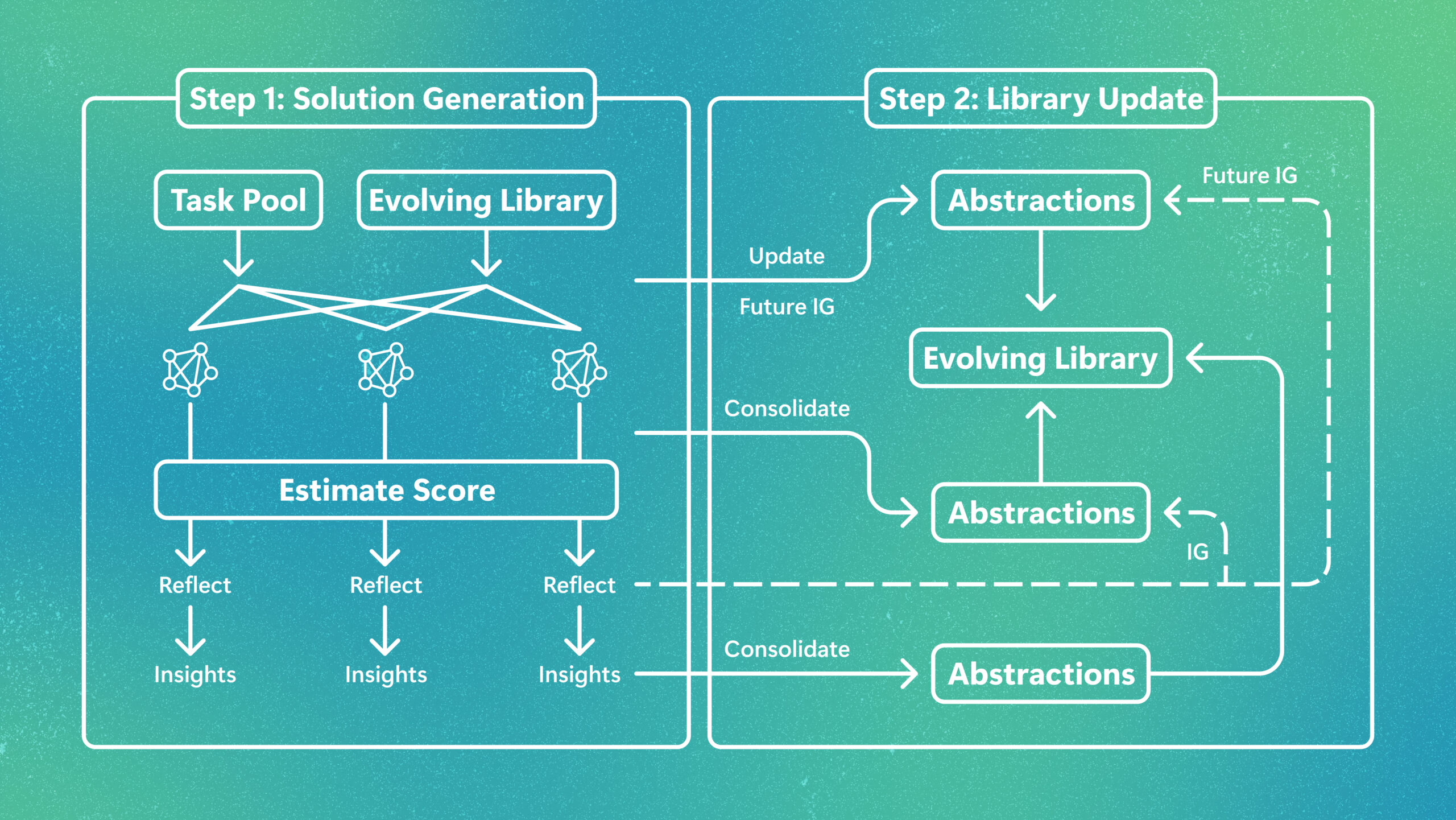
In our recent paper, Test-Time Learning with an Evolving Library, we explore how AI systems can learn from experience in a similar way. We introduce EvoLib, a framework that transforms raw experience into an evolving library of knowledge. Rather than treating memory as a growing archive of past experiences, EvoLib extracts reusable knowledge from those experiences and continually refines it as new experiences arrive. Through the evolution of library, skills become more general, insights become more accurate, and downstream performance gets improved consistently over time. In this way, AI agents can continually learn from accumulating experience without updating the underlying model.
Unlike traditional AI memory systems that store raw experiences as static information, EvoLib is built around the idea of evolving knowledge . In EvoLib, a unit of knowledge can take the form of a reusable skill distilled from a successful solution or a reflective insight learned from mistakes.
Source link