This article has been reviewed according to Science X's editorial process and policies. Editors have highlighted the following attributes while ensuring the content's credibility:
Researchers from the Department of Electrical and Computer Engineering under the Faculty of Engineering at the University of Hong Kong (HKU) and the Center for Advanced Semiconductors and Integrated Circuits (CASIC) have developed an ultra-wide bandgap (UWBG) semiconductor gallium oxide (Ga₂O₃) power module capable of handling megawatt-level power conversion, opening new possibilities for compact and highly efficient power systems in areas such as power grids, medical equipment and fusion energy.
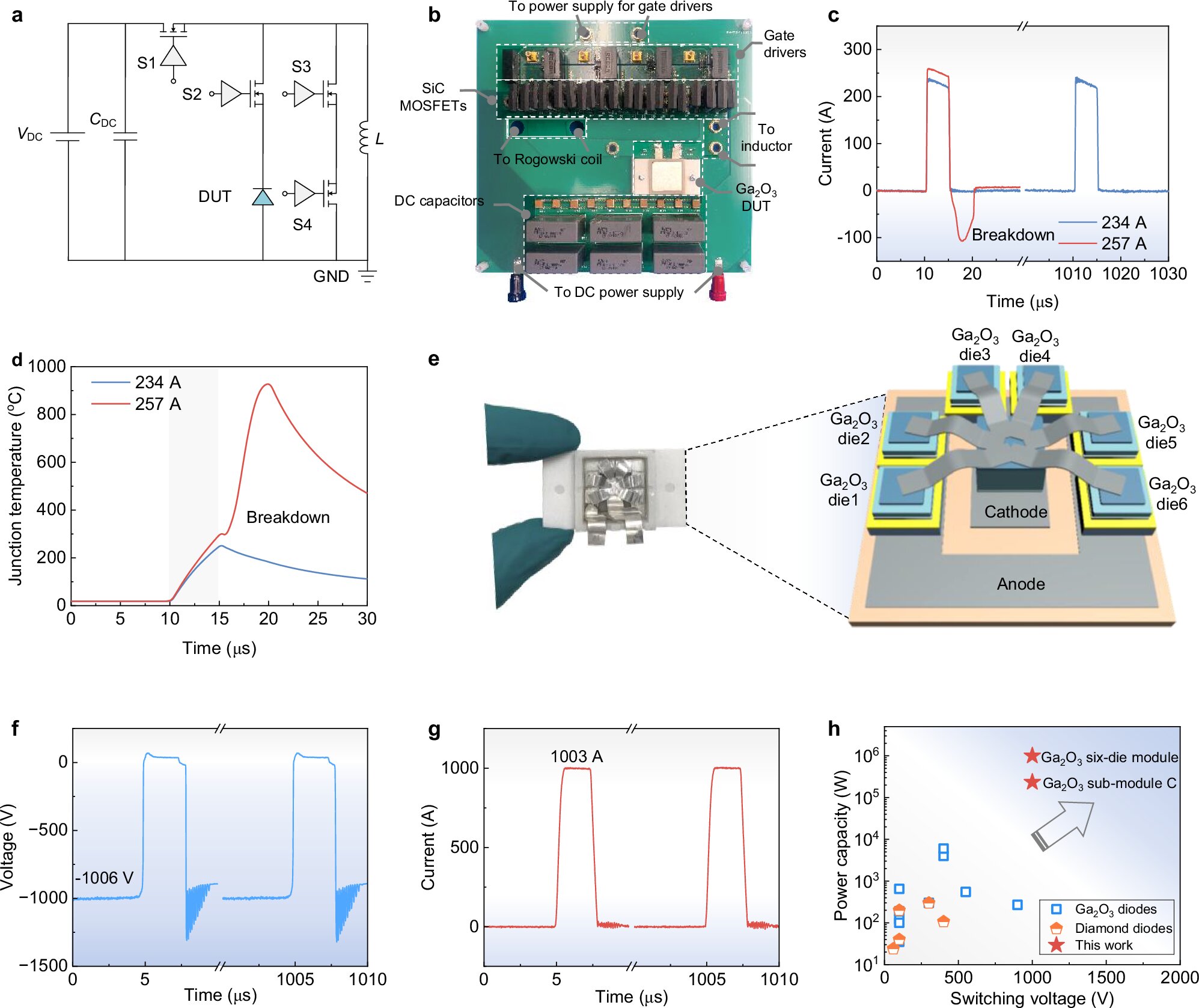
Led by professor Yuhao Zhang, Dr. Hehe Gong and Ph.D. student Xin Yang, in collaboration with professor Guo-Quan Lu from Virginia Tech and professor Jiandong Ye from Nanjing University, the team demonstrated a multi-chip Ga₂O₃ power module capable of repeatedly switching 1,000 volts and 1,000 amperes. This technology, now published in Nature Communications, represents more than a two-order-of-magnitude increase in the power capability previously demonstrated using UWBG semiconductor technologies.
Power semiconductor devices act as the "switches" that control and convert electricity in modern systems, from AI data centers and electric vehicles to renewable-energy systems and power grids. Conventional silicon devices are approaching their physical limits, while newer wide-bandgap semiconductors such as silicon carbide and gallium nitride have enabled major improvements in efficiency and power density.
Gallium oxide belongs to an emerging class of materials known as UWBG semiconductors. Its ability to withstand extremely high electric fields makes it highly attractive for future high-voltage electronics.
Source link