In April, we released DharmaOCR, our specialized structured OCR model (available on Hugging Face) along with a paper detailing the methodology behind it and a benchmark demonstrating its superior quality and cost efficiency. The paper benchmarked leading vision-language model families - both open-source and commercial - on a structured document extraction task: OCR on Brazilian Portuguese text. Among the reported metrics was text degeneration rate: the frequency with which a model produces a repetition loop instead of a transcription.
Across the tested open-source families, vanilla degeneration rates ranged from below 1% to above 33%. Supervised fine-tuning reduced those rates for most models - but rarely to production-acceptable levels. The pattern points to a structural limitation: SFT optimizes for correct outputs, but does not explicitly penalize degeneration. There appears to be a ceiling on how much task-focused fine-tuning alone can reduce this failure mode (Text Degeneration Article).
A second training stage - applied after supervised fine-tuning (SFT), on the same documents, using the same model - reduced text degeneration in every family tested. No exceptions. Average reduction: 59.4%. Best case: 87.6%.
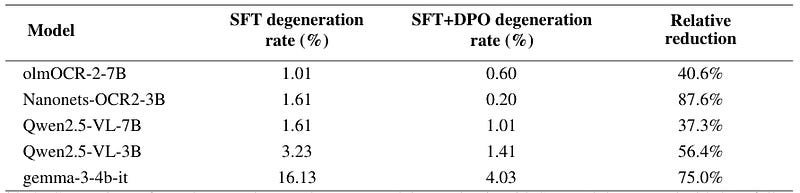
Figure 1: DPO reduced degeneration relative to SFT in every family tested - average reduction of 59.4%, peak of 87.6% (Nanonets-OCR2–3B: 1.61% to 0.20%). The direction is invariant; only the magnitude varies.
That second stage was Direct Preference Optimization (DPO). , 2023). OCR carries none of that subjectivity: the task is objective, and there is no conversational context. There is, however, a clear preference signal. A correct transcription is chosen; a degeneration loop is rejected.
Source link