
This article has been reviewed according to Science X's editorial process and policies. Editors have highlighted the following attributes while ensuring the content's credibility:
If computer chips could be built from semiconductors just one atom thick, they could pack far more transistors into a smaller space while using less power. So far, however, the technology has been held back by the weakness of "p-type" transistors, which make up half of every modern chip.
In a new study published in Nature, researchers led by Vincent Tung at the University of Tokyo have shown that atom-thin sheets of boron carbon nitride (BCN) could offer a promising solution.
Today's chips rely on two types of transistors working in pairs. In "n-type" transistors, electric current is carried by negatively charged electrons. In "p-type" transistors, it is carried by holes: vacancies left behind when electrons are missing from the material, which move around like positive charges.
Researchers have found several atom-thin materials that carry electrons very well, but finding counterparts that carry holes just as well has proven far harder, creating a bottleneck for the whole technology. Many candidate materials so far have involved trade-offs: They conduct poorly, break down in air or heat or are difficult to make on large scales.
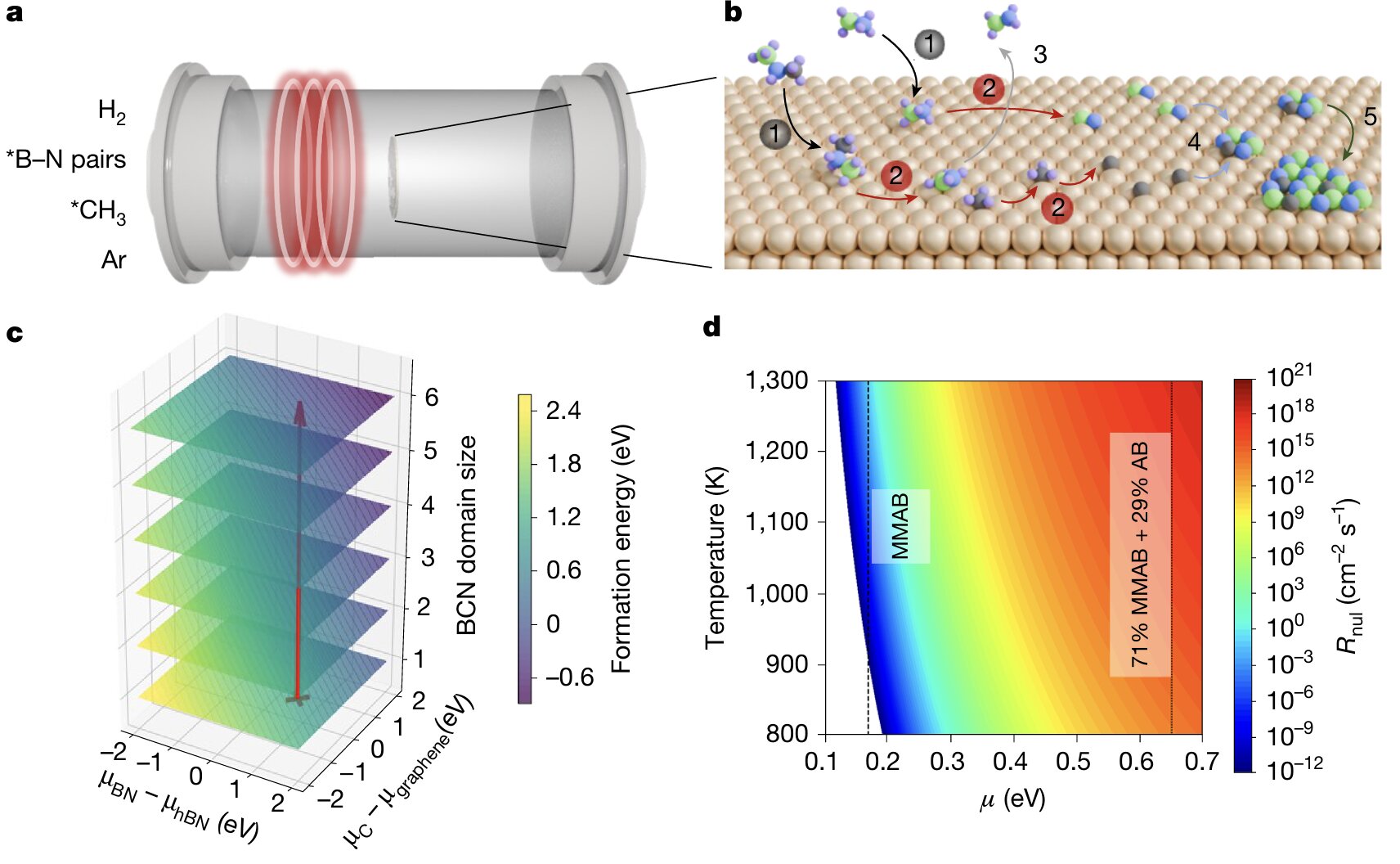
Tung's team tackled this problem by replacing some nitrogen atoms in boron nitride, an atom-thin insulator with a honeycomb structure, with carbon.
To prevent the carbon atoms from clumping together, the researchers used two vapor-based ingredients: one that steadily supplied boron and nitrogen and another that released its carbon slowly.
Source link





