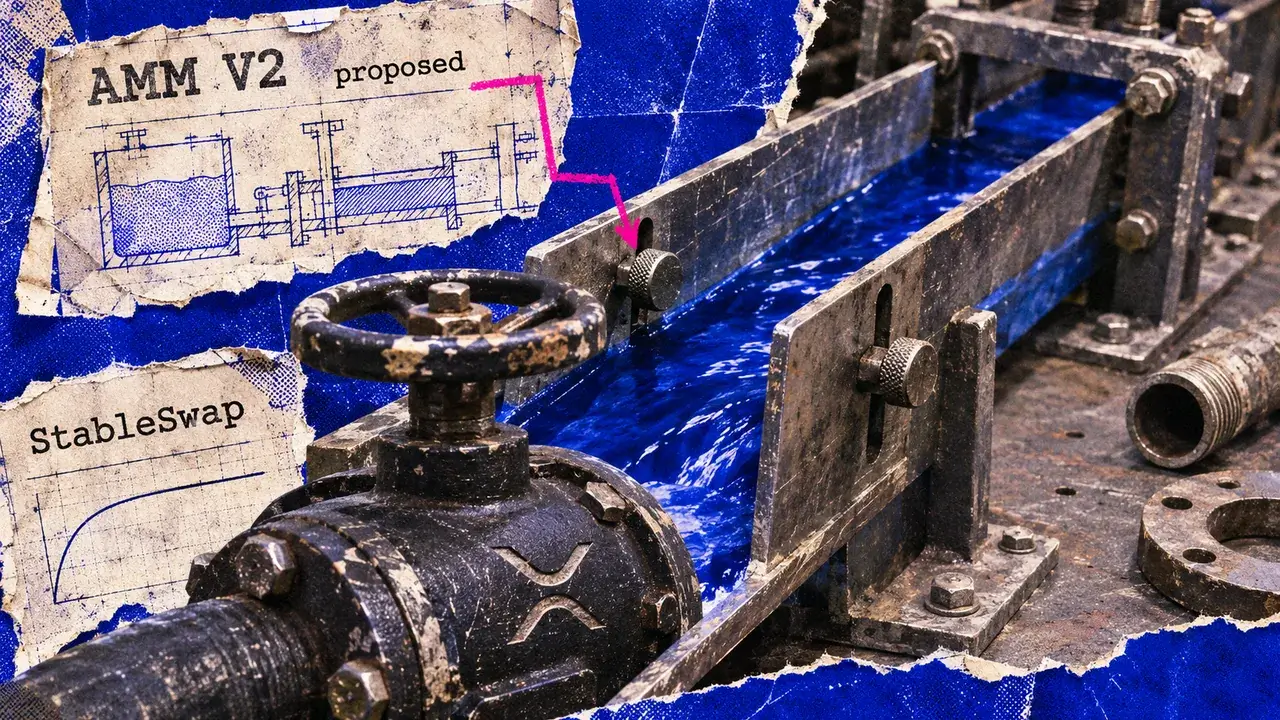
New pool-pricing curves could improve execution, but additional XRP holding demand would depend on adoption, routing and persistent funding.
The XRP Ledger’s proposed AMM V2 overhaul would let creators of automated trading pools choose how those pools price trades, potentially giving traders more usable liquidity for the same deposit. For XRP holders, the potential benefits are better execution and new ways to provide liquidity; additional demand to hold the token would depend on which assets and routes attract capital.
The distinction is visible in today’s pools. XRPSCAN responses retrieved at 13:15 UTC on Nov. 15 showed roughly 25,065 of Ripple’s dollar stablecoin RLUSD and 25,068 of Circle’s USDC in the RLUSD/USDC pool, about $50,133 if both stablecoins are valued at $1. The XRP/RLUSD pool held about 1.94 million XRP and 1.88 million RLUSD.
Those are reserve snapshots, not amounts a trader could exchange at an unchanged price. They also illustrate two different inventory needs: the first pair holds two stablecoins, while the second holds XRP.
CryptoSlate’s XRP page displayed $0.97 when retrieved at 13:15 UTC on Nov. 15, with market data marked as updated eight minutes earlier.
An automated market maker, or AMM, lets users trade against a pool whose prices follow a formula. XRPL’s current design uses a constant-product-style curve. Liquidity supports trading across a broad price range, even when the assets usually trade close to one another.
The AMM Swappable Curves draft proposes alternatives. StableSwap would concentrate effective depth near the expected relationship between correlated assets, such as two dollar stablecoins.
Source link