S&P Global made no downward adjustment in its latest Stablecoin Stability Assessment, as 5 is the lowest available score.
S&P Global Ratings has kept Tether’s USDt at the lowest level on its stablecoin stability scale as riskier assets take up a growing share of the token’s reserves.
In a report published Nov. 18, S&P scored USDt’s ability to hold its dollar peg at 5 (weak). The assessment is unchanged from November 2025.
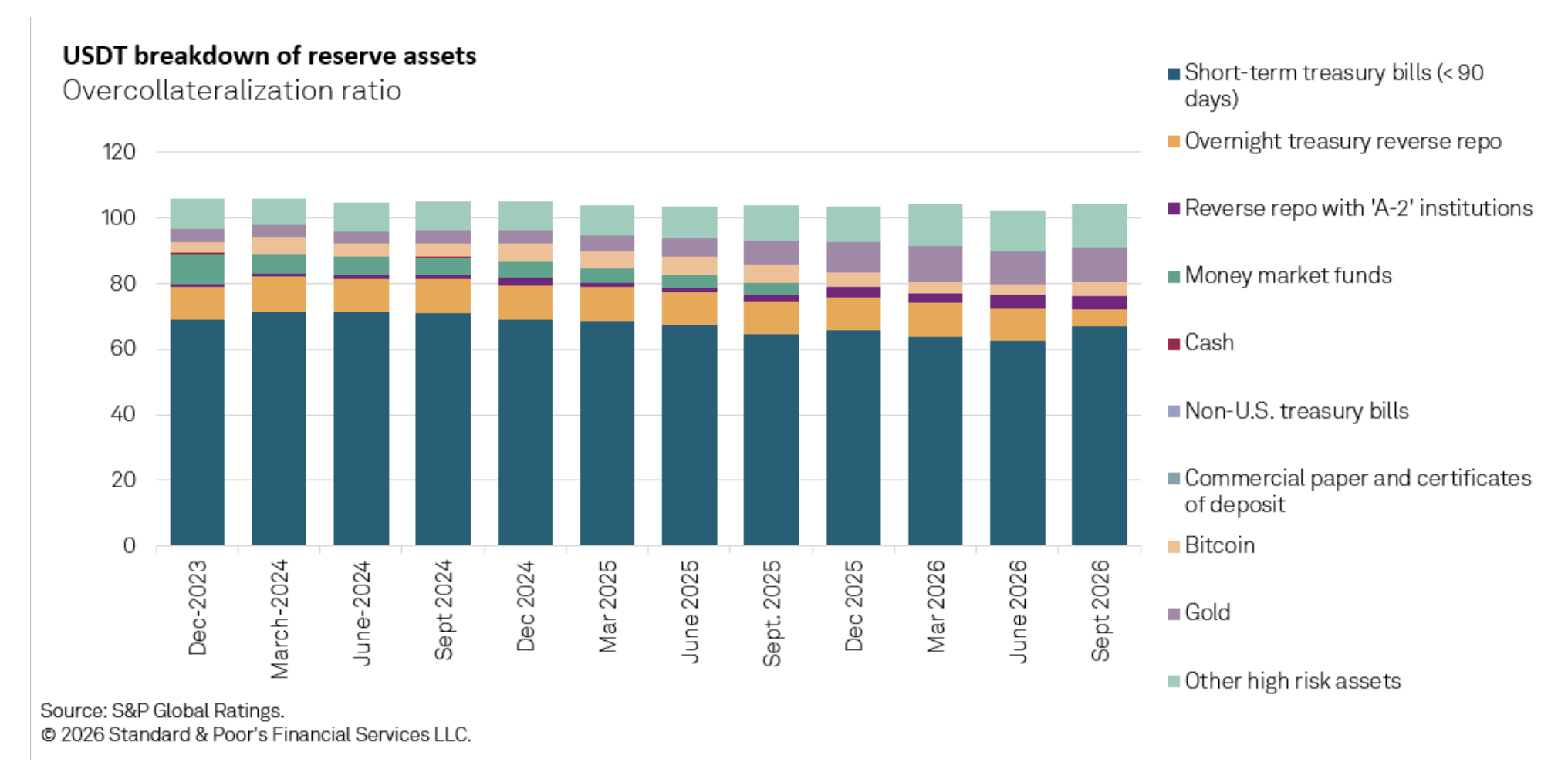
Higher-risk holdings, including gold, Bitcoin (BTC), public equities, secured loans and corporate bonds, were equivalent to 28% of USDt (USDT) in circulation as of Sept. 30, up from 24% a year earlier. “A significant drop in the value of these assets could lead to USDT being undercollateralized,” S&P said in the report.
“The problem is S&P’s framework, not our reserves,” Tether told Cointelegraph. “Their own history shows the underlying problem,” it added, referencing The Big Short, the film about the 2008 financial crisis.
Tether’s Sept. 30 reserve report, attested by BDO, showed approximately $191.5 billion in assets against $183.5 billion in liabilities, leaving roughly $7.95 billion in excess assets. The agency added that it found further weaknesses but made no downward adjustment “because our assessment cannot be lower than 5.”
Among the additional weaknesses highlighted by S&P was the regulatory oversight of El Salvador, where Tether relocated in January 2025.
According to the report, the National Commission of Digital Assets of El Salvador (CNAD), the regulatory body which oversees Tether in the country, requires 70% of the reserves to be held in assets that can be liquidated within 30 days.
Source link