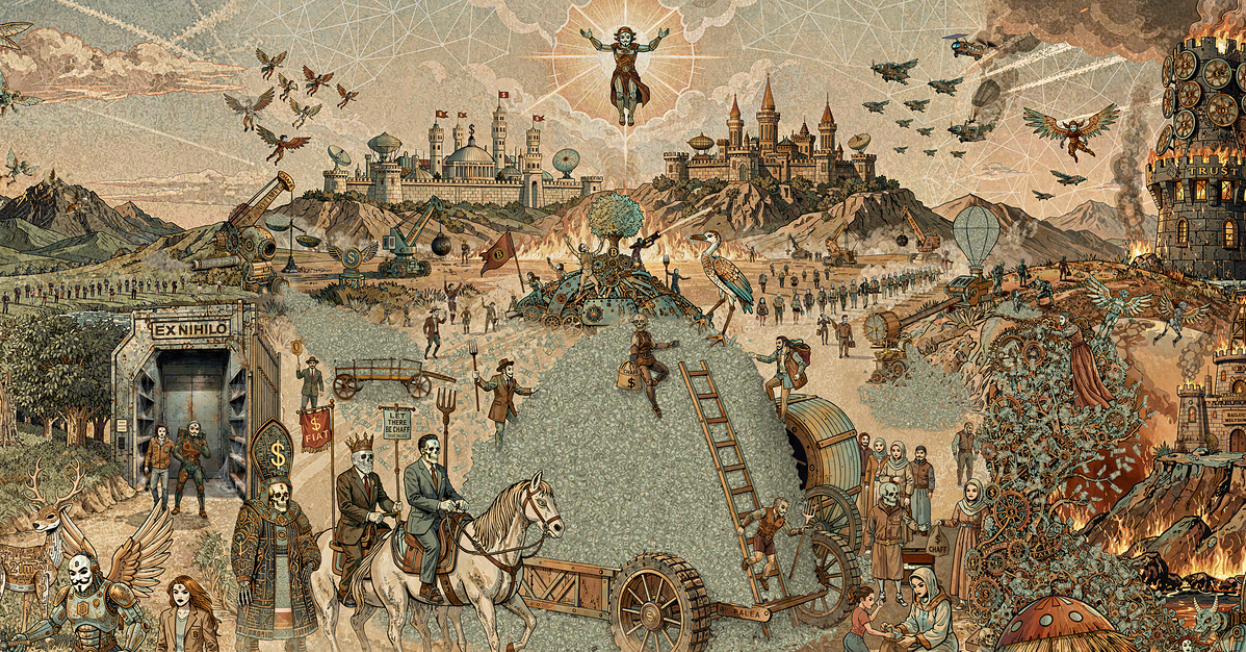
On August 15, 1971, Richard Nixon announced that he had directed Treasury Secretary John Connally “to suspend temporarily the convertibility of the dollar into gold.” The suspension was never lifted. Fifty-five years later to the day, Lucho Poletti unveiled the first of ten drawings responding to that decree.
Europe had experienced its own monetary upheavals. Hieronymus Bosch and Pieter Bruegel the Elder worked during an era of expanding banking, credit, and speculation. Antwerp, where Bruegel worked, became one of Europe’s great commercial centers. Both painters populated their compositions with hundreds of figures, constructing elaborate worlds in which human behavior, social order, and moral judgment could be examined simultaneously.
Bitcoin artists have increasingly returned to this visual tradition. Pepenardo’s Master Cuts Out the Stone, exhibited by BMAG earlier this year, reimagined Jan Sanders van Hemessen’s The Surgeon as a study of who extracts and who is extracted from. Carlijn Kingma’s The Waterworks of Money, shown at Bitcoin Amsterdam last year, depicted the modern monetary system as an interconnected landscape. Complex systems seem to invite pictures that hold everything in a single frame.
Lucho Poletti has made bitcoin-related art since 2017, describing his practice as visual propaganda for the monetary revolution. A contributor to the Bitcoin Conference art gallery since 2021, he returns to Bitcoin Amsterdam this November with Ten Decrees.
The series reimagines ten paintings, four by Bosch and six by Bruegel, around money. Fiat , Latin for “let it be done,” becomes the organizing principle. Nine titles issue commands: let there be fury, profit, chaff, a game, folly, hunger, refuge, collapse, and ash.
Source link