Starknet's STRK token more than doubled over seven days while developers considered leaving Ethereum to build an independent Layer 1 blockchain.
A CoinGlass snapshot checked at 20:28 UTC on Oct. 11 showed STRK at $0.1190, up 17.7% over 24 hours and 116.7% over seven days.
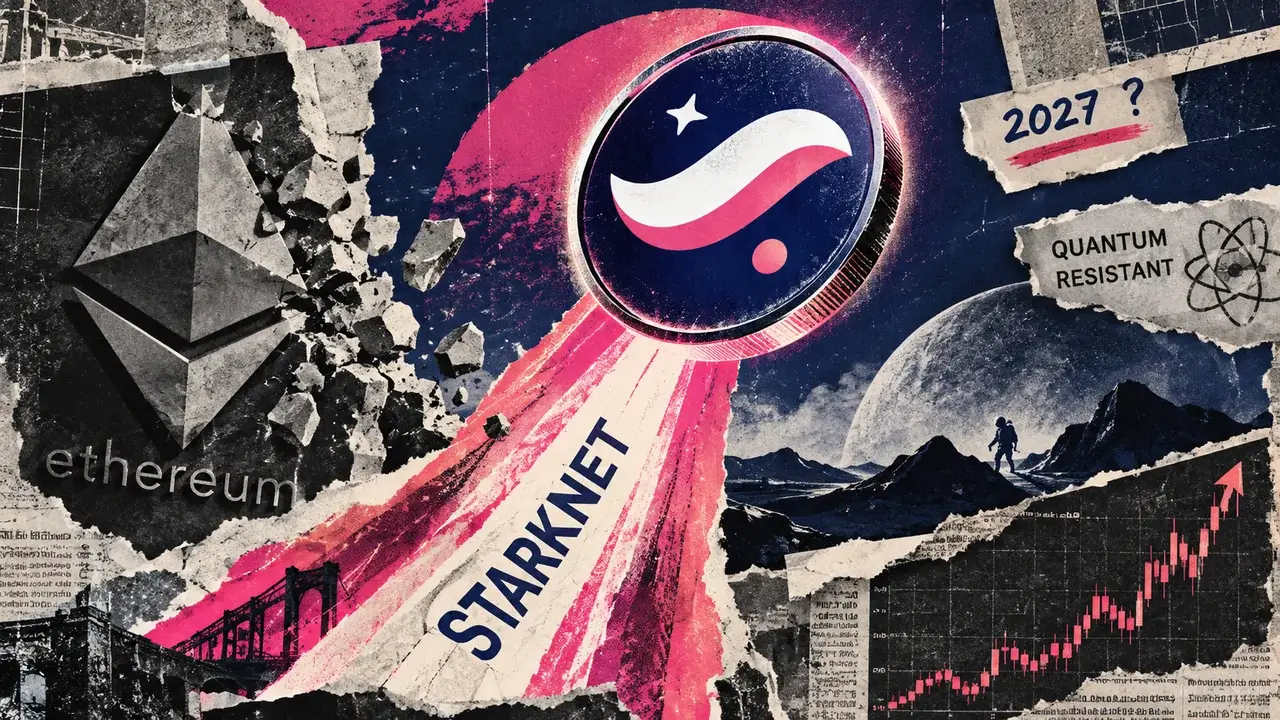
On Oct. 8, Starknet said it was actively considering becoming an L1, with 2027 as its target for what it described as the first fully quantum-resistant network. The proposed move would replace its dependence on Ethereum's underlying security infrastructure.
StarkWare CEO Eli Ben-Sasson has framed the potential transition as a response to growing concerns that advances in quantum computing and artificial intelligence could undermine existing blockchain cryptography.
In an X post, Ben-Sasson argued that the quantum threat could arrive sooner than expected and that increasingly powerful AI added urgency to preparations. The debate follows recent AI-assisted advances in mathematical research.
His argument concerns preparing for a cryptographically relevant quantum computer; it does not demonstrate that AI can already break deployed blockchain signatures.
Starknet's ZK-STARK proof system relies on hash-based cryptographic assumptions rather than the elliptic-curve mechanisms vulnerable to sufficiently powerful quantum computers.
The network also supports programmable accounts, letting users adopt alternative signature schemes without a network-wide upgrade.
In June, StarkWare published a three-phase roadmap covering vulnerable hashing mechanisms, legacy smart contracts and dependencies inherited from Ethereum. The first two phases are within Starknet's control; the third depends on Ethereum's migration.
Starknet currently operates as an Ethereum Layer 2 , processing transactions separately while relying on Ethereum for settlement and data availability.
Source link